Team & agility
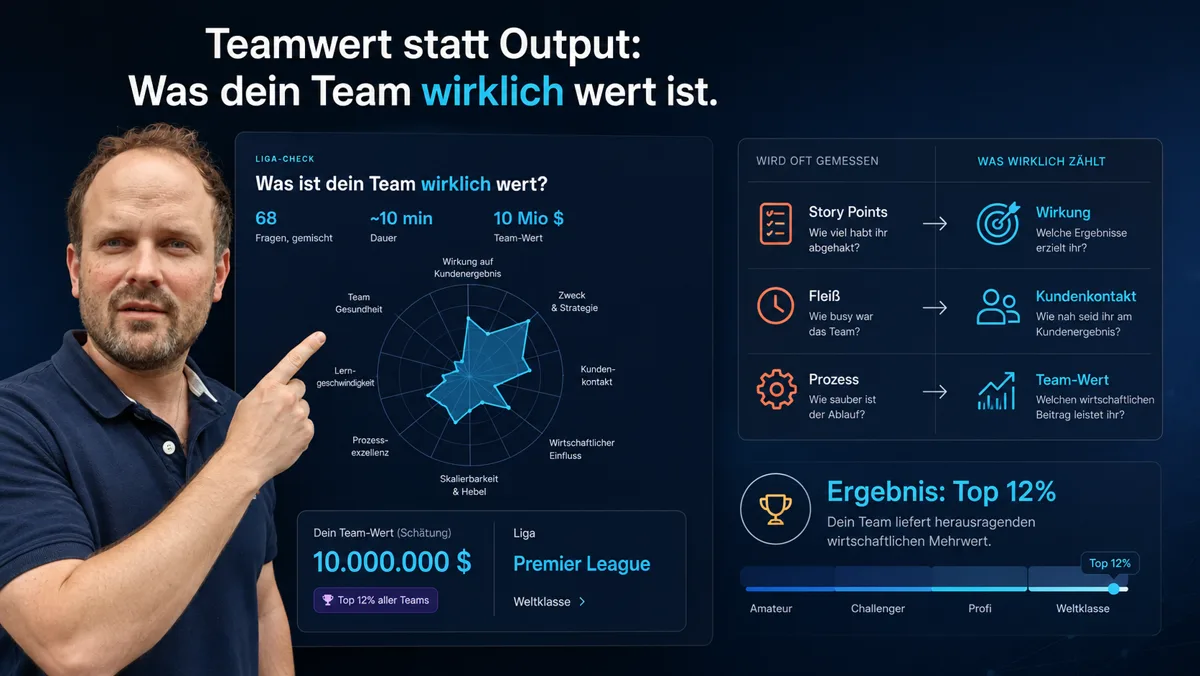
What is my software team really worth?

 AI
AI"I always knew how many story points our team delivered last sprint, but what our work was actually worth — I had no idea."
Sound familiar?
I mean, every software team with any self-respect does Scrum these days. But how do you actually tell whether you are good?
A while back a tool like this one would have made things a good deal easier — but working your way this deep into the subject while the day job is going on? That was simply not happening.
So I built you a tool to work out your team value. The result is not 100 % scientifically watertight, and I would not price an acqui-hire on it (that is when a team gets bought), but you get a pretty good first impression.
If you need it more precise, or you are simply interested in top teams and how they are valued, I would point you to my book on it.
A small warning: do not go in with high expectations of your team value, and it may well come out better than you thought. In most cases you do not need a top team anyway — sometimes you just want one.
Does team value need hard work?
 AI
AIMy book features Andi. A Product Ownerwho has been delivering very reliably for what feels like forever. On time, clean work, disciplined team. Perfect, surely?
Then the head of product role opened up, and who did not get it?
You can guess: Andi, of course.
And the reason was explicitly not poor work.
So what was it?
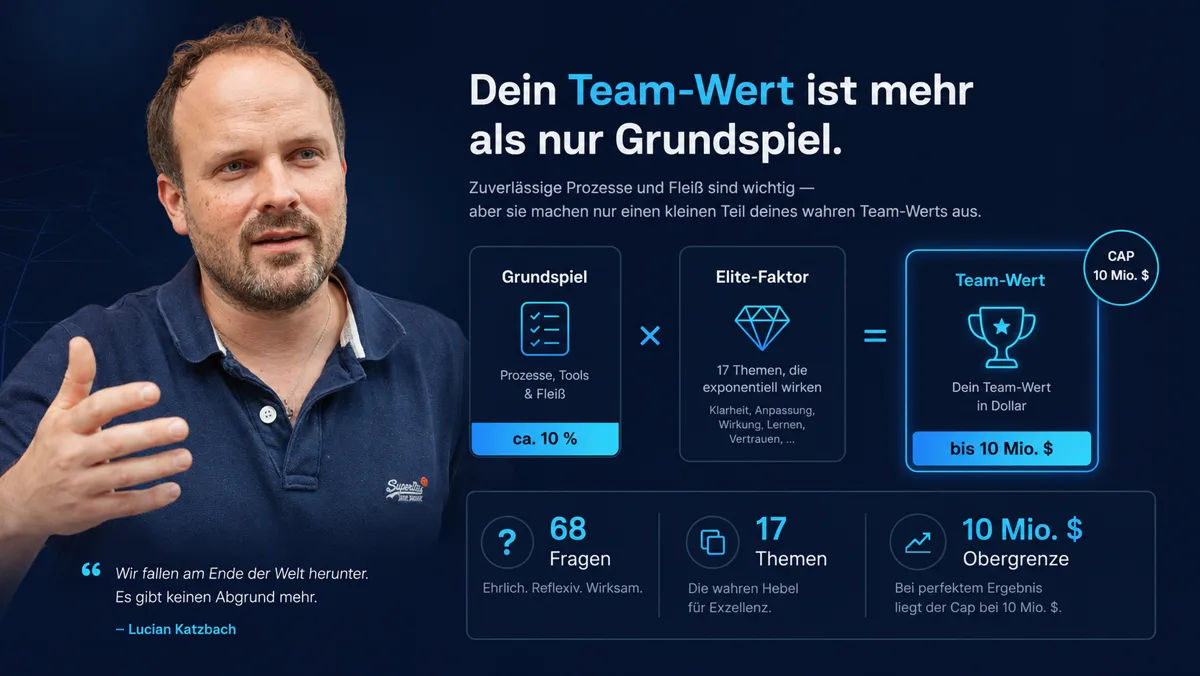
It was that diligence and sticking to the process make up only a fraction of what a team is worth commercially. Make sense? Probably not yet.
There is a very large study (Verwijs & Russo, with nearly 2,000 Scrum teams) showing that the basics are reliable processes, clean communication and collaboration that works. And teams who have mastered those basics still fall systematically — systematically! — short of their potential. Striking, isn't it?
All right, you can probably see it coming. What you probably cannot see coming is how big the gap is.
A quick guessing game: how much of the total do you think the basics account for?
10 percent, 45 percent or 75 %?
Got a number written down in front of you?
Good. Because it is around 10 %.
Which means a team that has mastered the basics sits at 10 % of its potential. And I will say it again: NOT because they work badly, but because they are sharpening the axe in the wrong place.
So where does this elusive team value actually come from?
 AI
AIThis has nothing to do with feelings. Yes, you can like your team, yes, you should like your team, and YES, letting it go in a sale is going to be hard when you have put a great deal into it.
But a financial valuation stays a number.
There are, in the end, a few building blocks worth looking at when working out a Scrum team's value.
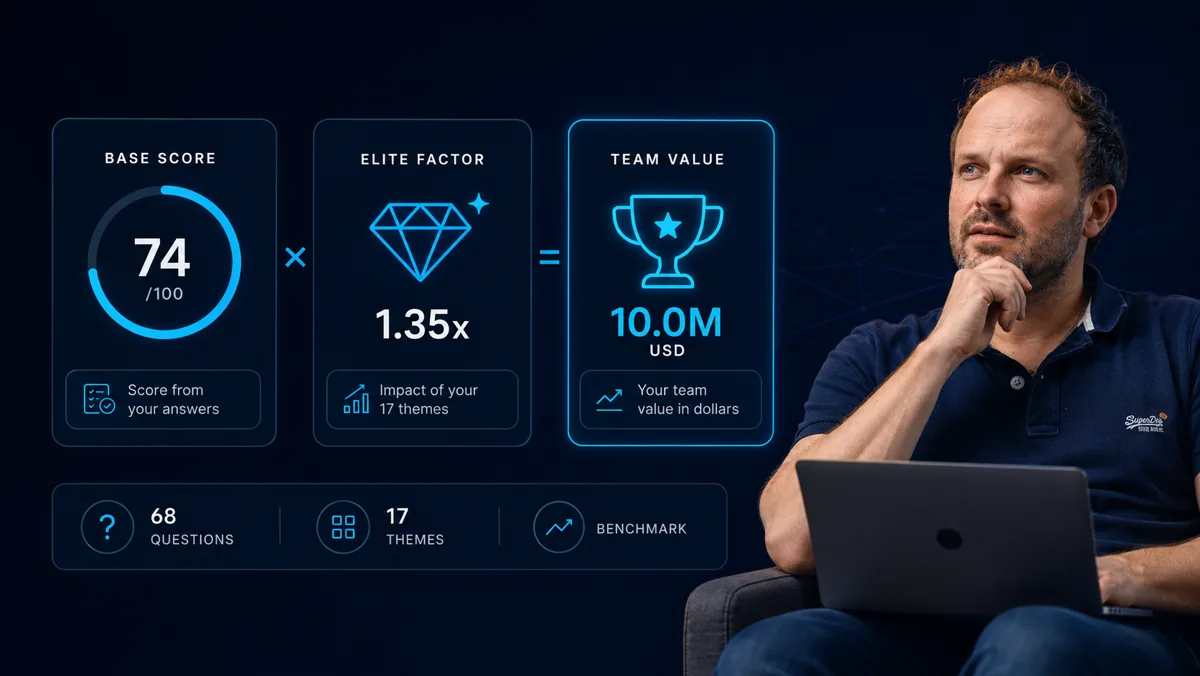
First, there are twelve basic competencies. Things like reporting your own bugs rather than waiting for users to do it, spotting blockers early, communicating delays, learning from delivery data — from the last few sprints, that is. That sort of thing.
They are necessary, but fundamentally interchangeable. Most of it we ALL learn, more or less well, at school.
Which means, put the other way round: almost any team can learn these basics. Make sense?
It gets interesting the moment we talk about the "elite factor": five rare behaviours that decide the commercial value out of all proportion to their number.
You have probably heard this a hundred thousand times, in every Scrum talk, every Scrum course, every Scrum unconference: the sprint goal should influence real decisions, not just get mentioned once in sprint planning.
You know how it goes: the team gets asked briefly, everyone agrees with the sprint goal, and then nobody cares any more…
The research says the definition of done matters more than people give it credit for. Google that if it means nothing to you right now.
I know what is coming next is genuinely annoying, and it would be much nicer if we could strike it from the job entirely — but contact with actual human beings (customers, I mean) makes an enormous difference to a team.
The DORA figure, for what it is worth: 40 percent higher organisational performance — the single strongest value driver in the research.
And the fourth is retrospectives that ACTUALLY change something, rather than ending with everyone nodding and then wondering at the end of the next sprint whether anyone remembers what was decided. Familiar, no?
The fifth is contributing to the product outcome rather than to ticket throughput — and what ends up being measured.
What matters, in the tool as well, is that the base score and the elite factor are not added but multiplied. Why? Because it takes its cue from professional football, where stamina alone has never won a promotion. Now it makes sense, doesn't it?
The fact is that a low elite factor drags an excellent base score down NOTICEABLY — and I mean noticeably.
Which is why the team value often comes out lower than gut feeling would suggest.
STOP RIGHT THERE: a low team value is NOT a warning sign!
 AI
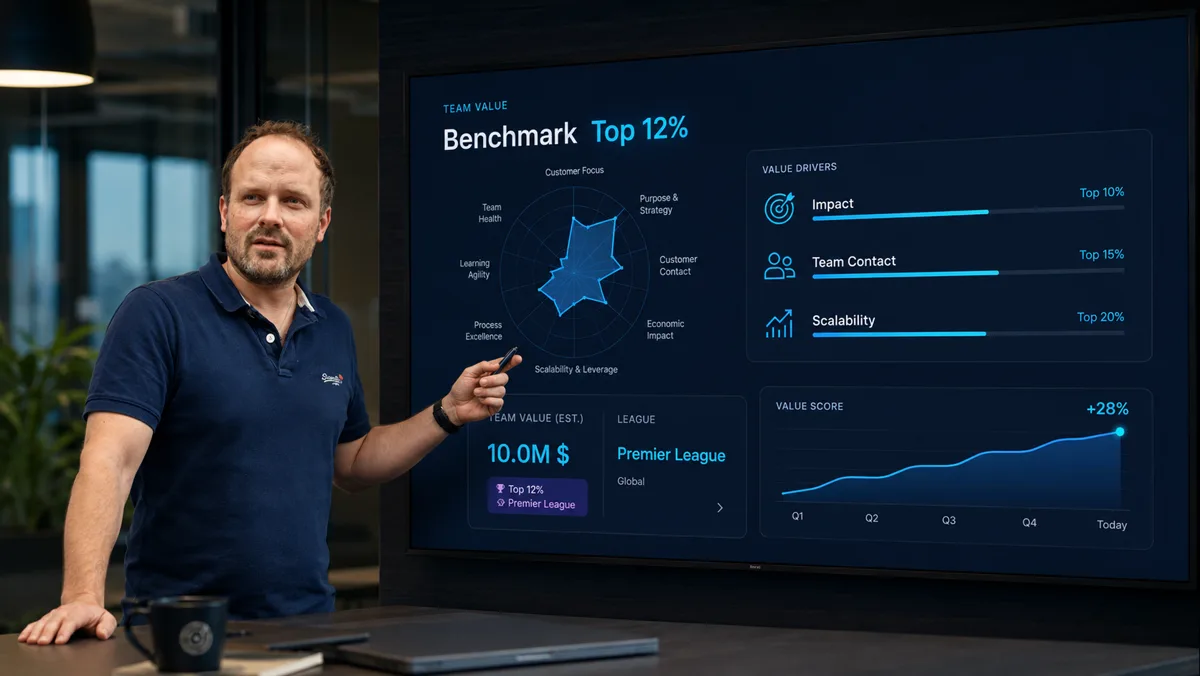
AIA high team value is rare by definition. You may know the example of 82 % of German drivers considering themselves above-average drivers. Notice something? That cannot possibly work.
In football it is starker still: only around 3.5 % of academy players make it into Europe's top five leagues.
There is certainly a discussion to be had about what counts as elite. But taking it loosely and following the DORA research, only 7–26 % of organisations reach anything like elite status.
Which means: if your team value lands somewhere in the middle, you are in good company.
So it is not about whether you will ever join the world elite, but whether you are trying.
So how does team value come about?
 AI
AIThe team value check asks 68 questions across 17 topics and mixes them up, so you cannot say the valuable questions are all at the beginning or the end.
So please finish it. I know 68 questions is a lot, but you do want something halfway solid.
One thing matters: none of the questions asks how you feel. This is about measurement. From memory is fine, but not from gut instinct alone.
If you really want to know, observe. (Tip: your Scrum master can be an excellent place to start.)
Instead every question asks for a specific point in time: when this or that behaviour last occurred.
You can take the test even if you are not a Scrum team, though it uses sprints as its unit of time — the fixed period for a package of work.
Once all the answers are in, the tool has a ceiling. The scale tops out at $10 million, so as far as the tool is concerned your team cannot be worth more than that.
How I arrive at that number is in the book, if you want the detail.
And at the end the tool gives you concrete tips based on the answers you gave.
Time to find out your own team value!
 AI
AIThe check takes about 10 minutes and runs entirely in your browser, which means none of your answers are sent anywhere.
And here, finally, is the link to the tool:
If you want to go deeper — the full derivation of the formula, perhaps for a real acqui-hire question about your team — it is in my book "The 10 Million Dollar Team".
(LINK -> Coming soon — until then, just get in touch with me directly)