Team & agility
Flight Room – the team game for clear communication and collaboration

 AI
AI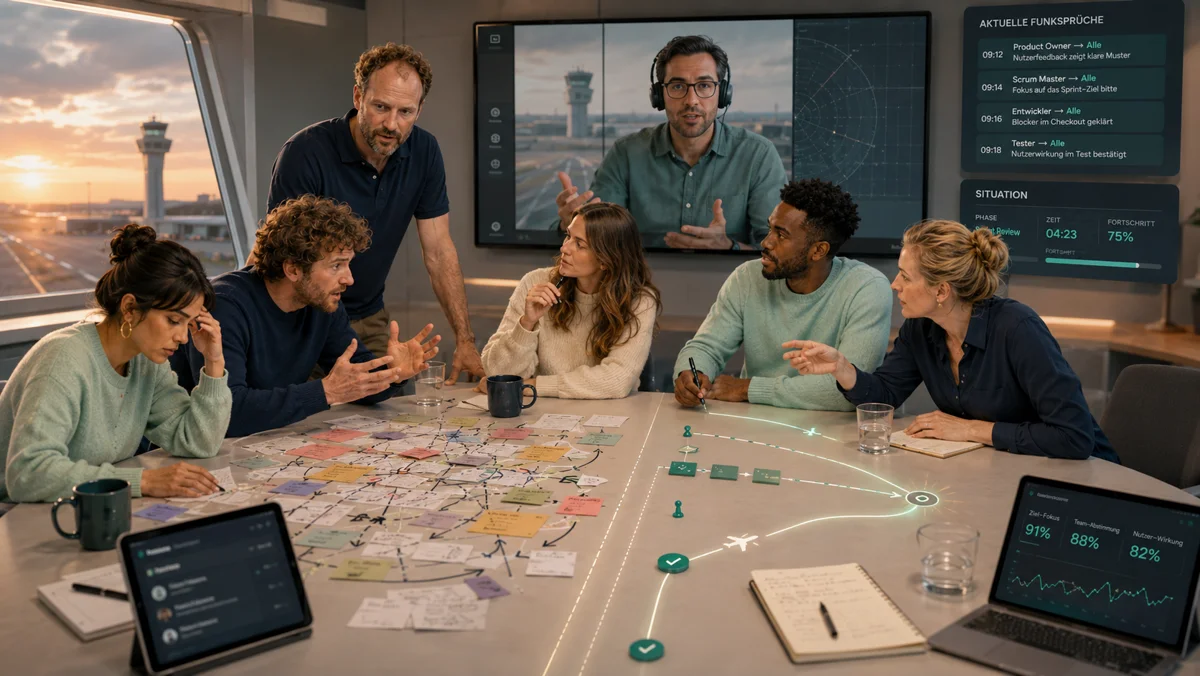 AI
AI
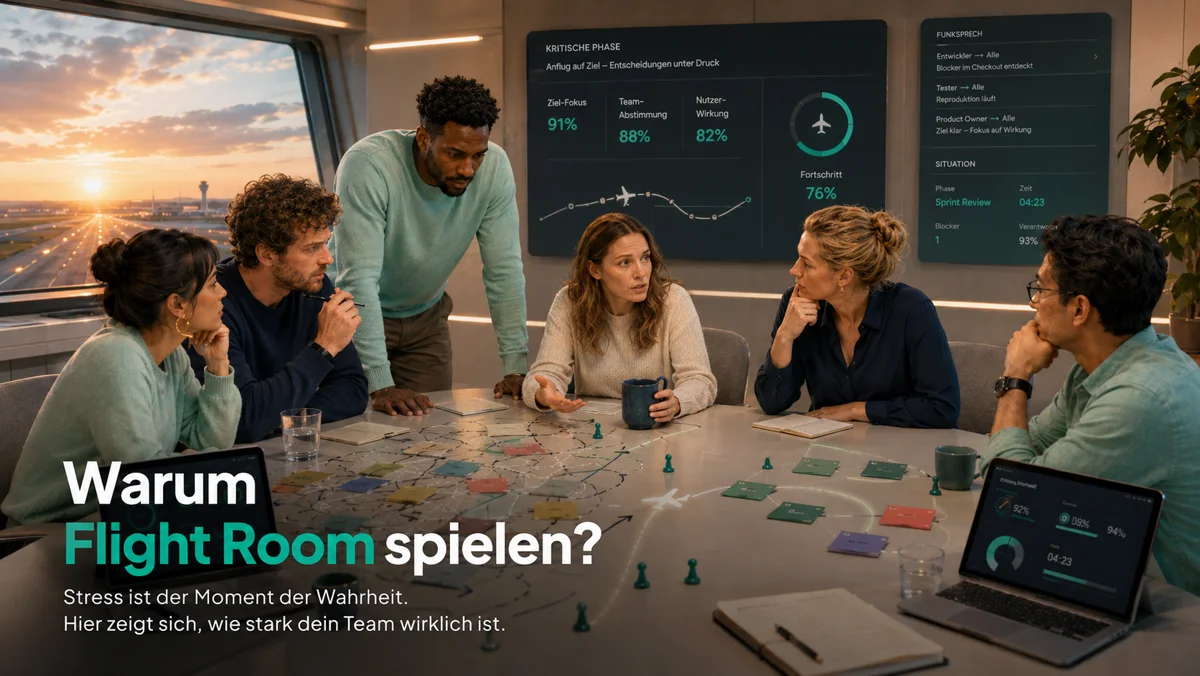
Why play Flight Room?
 AI
AIThe Flight Room role-play simulates a critical phase of flight in which the team has to solve a complex problem together — no external events, but a strong focus on internal coordination and responsibility.
What are you training?
- Communication under pressure: All players speak at the same time and have to agree on who takes the floor when. That way you practise keeping an overview in hectic situations and still sending clear messages.
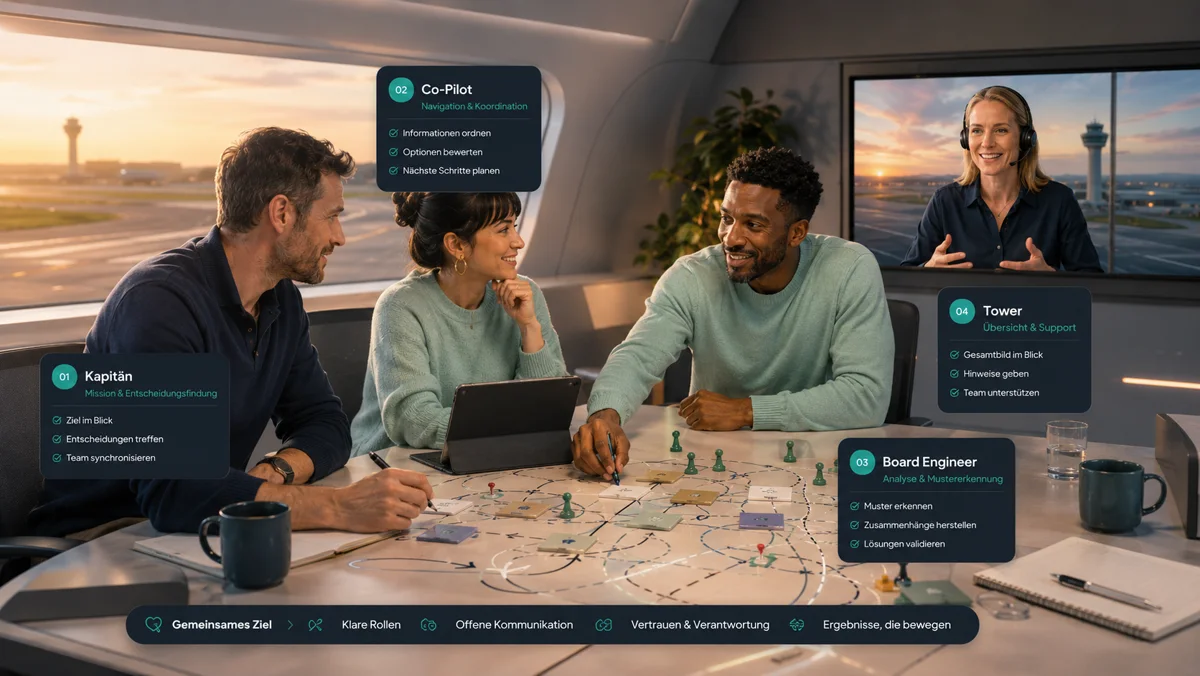
- Understanding roles and working together: Captain and co-pilot carry the responsibility together, while the flight engineer works out an understanding of the problem and its solution step by step through dice rolls. The tower supports with clear hints. Every role has an important function in the team. That simulates the different role dynamics of everyday work.
- Improvisation and decision making: With no external events the game concentrates on the dynamics inside the team. You learn to act flexibly and creatively — especially when unexpected situations arise.
- Patience and working step by step: The flight engineer's marker mechanic shows that solutions often do not come at once but have to be reached in small steps. It is much like real sprint situations with errors in the effort estimate. The goal still has to be reached, though — otherwise the plane "crashes".
- Trust and taking responsibility: The team feels how important it is to listen to one another, look out for one another and share responsibility in order to come through together.
This game is a safe space for trying out patterns of communication and developing a culture in which challenges are taken on together — an ability that gets you further not only in the Flight Room but in real everyday work.
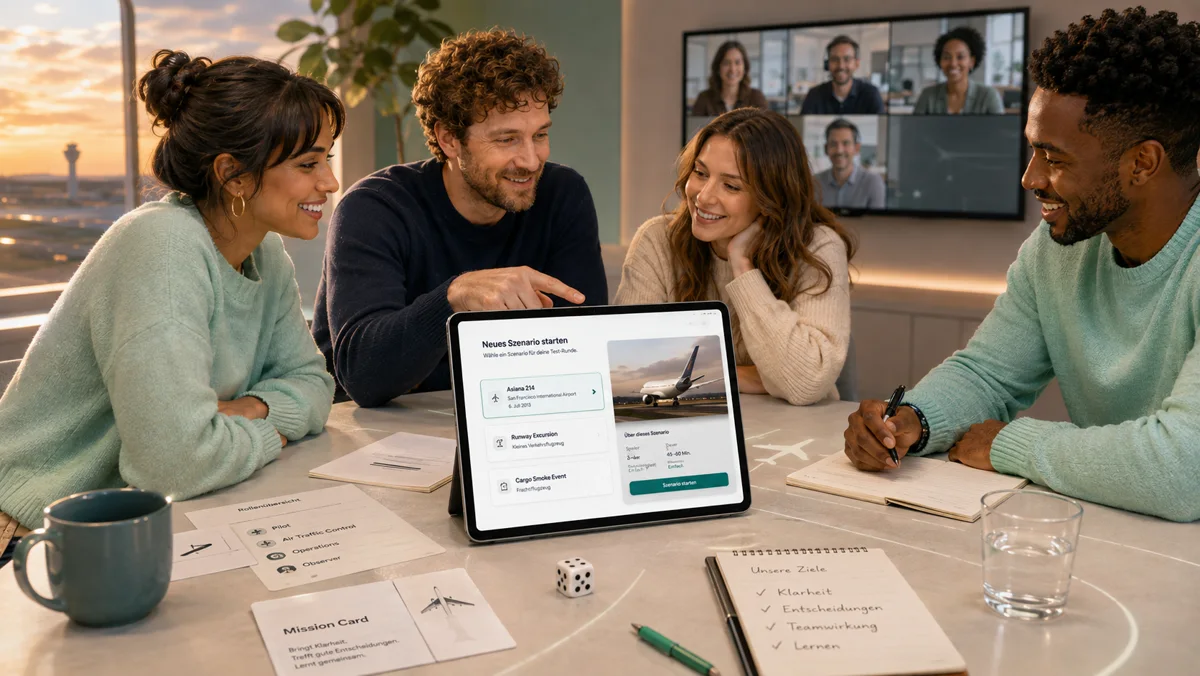
Flight Room — the simple trial version with the Asiana Airlines 214 scenario
 AI
AI👉 Start the scenario online and click on "Asiana Airlines 214":
-> UPDATE: FlightRoom is now available as a product for teams, with a free team-event mode!
All you need is 3–4 players, a six-sided die, pen and paper — and a little courage to improvise.
What you can achieve in this training:
A team experience that welds people together and shows up your team dynamics in moments of uncertainty. This is not about winning but about how you play together.
Roles:
- Captain
- Co-pilot
- Flight engineer
- Tower
How it plays:
- All players speak at the same time and have to work out among themselves who speaks when — there is no fixed order.
- The captain and co-pilot are responsible for solving the problem before they can land. Spoiler: a go-around is not possible, because fuel is limited.
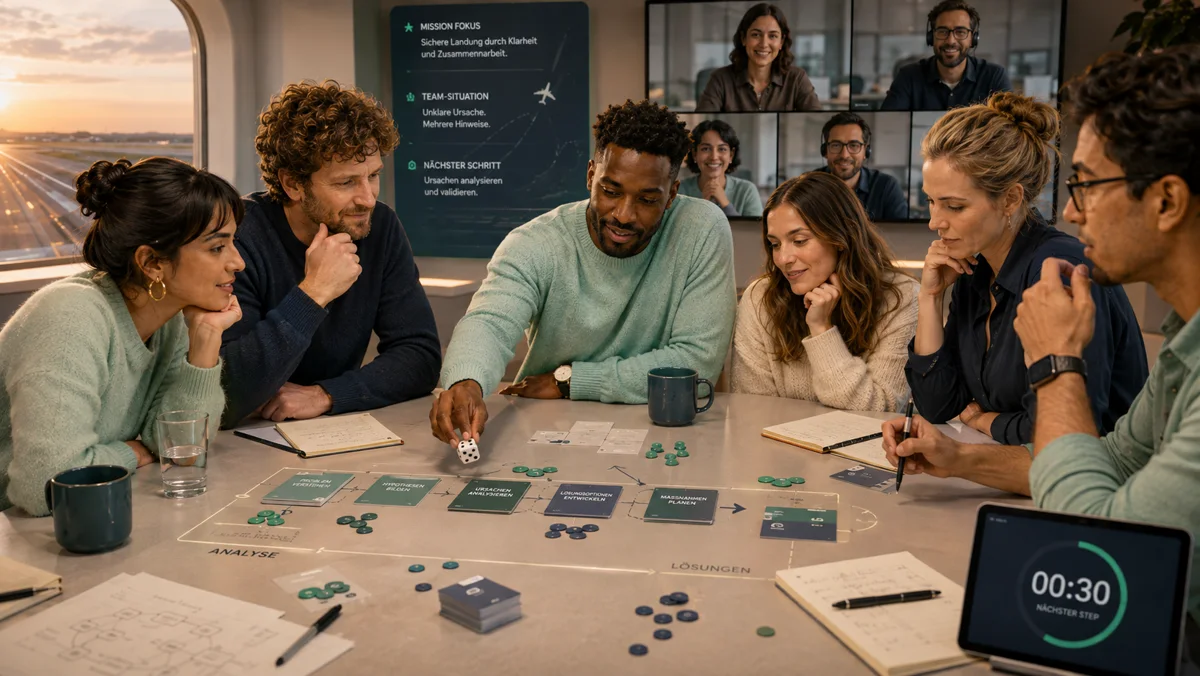
- The flight engineer analyses the problem and solves it with dice and markers (see below).
- The tower supports by improvising "from the ground"
- There are no external events or dice rolls apart from the flight engineer's analysis and solution mechanic.
The flight engineer's job:
Every 30 seconds they analyse the problem with a 1d6 roll:
- 1-3: 1 analysis marker
- 4-5: 2 analysis markers
- 6: 3 analysis markers
In total they need 4 analysis markers to complete the analysis.
Then they roll for the solution with the same distribution, to collect 4 solution markers.
Only once 4 solution markers are collected does the problem count as solved.
The role of the game master (optional):
- The game master makes sure the team does not stall or get bored.
- They respond to improvisation from the captain and co-pilot and keep the game flowing.
Have fun trying it out!
 AI
AIWhy I do not see gamification as a gimmick
 AI
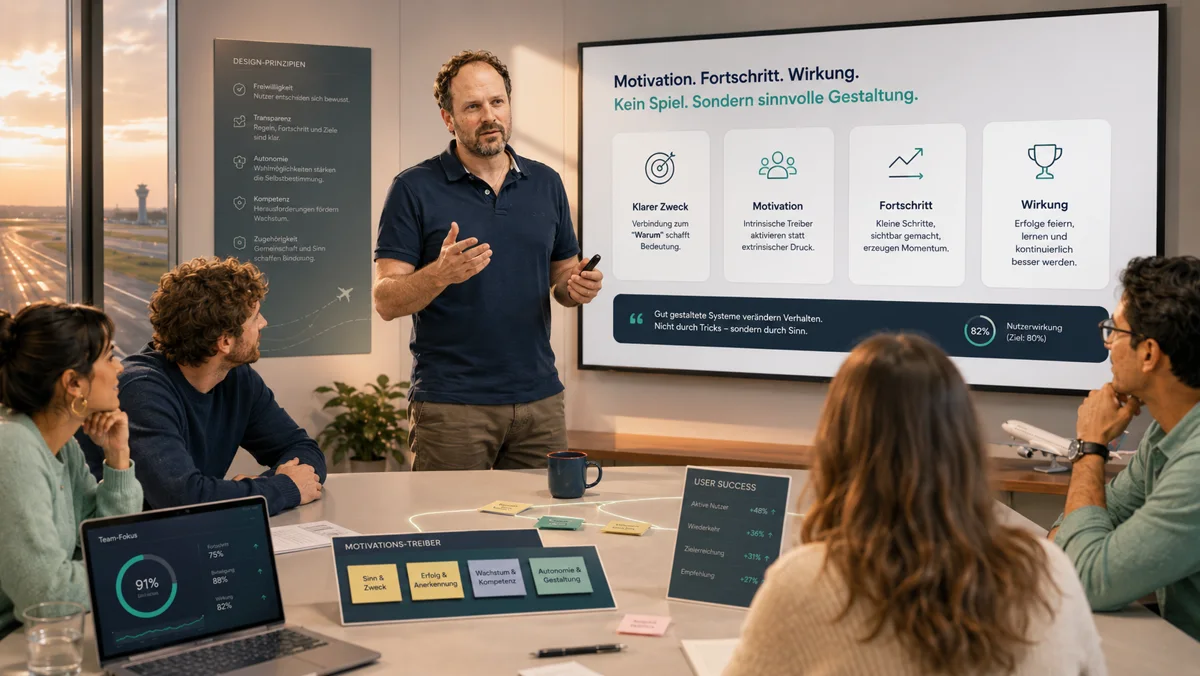
AII develop gamification in order to shape behaviour deliberately and make lasting user success possible — not only in teams but in digital products too. My focus is on human-centred designthat enables users to reach their goals, feel progress and stay with it.
That is where the real value arises — for users as much as for companies.
When digital products lead users systematically to success, motivation, Retention and ultimately revenue all rise. I work with psychological principles such as the Core Drives from the Octalysis framework of my friend Yu-Kai Chou — because features alone are not enough. What counts is how they are experienced.
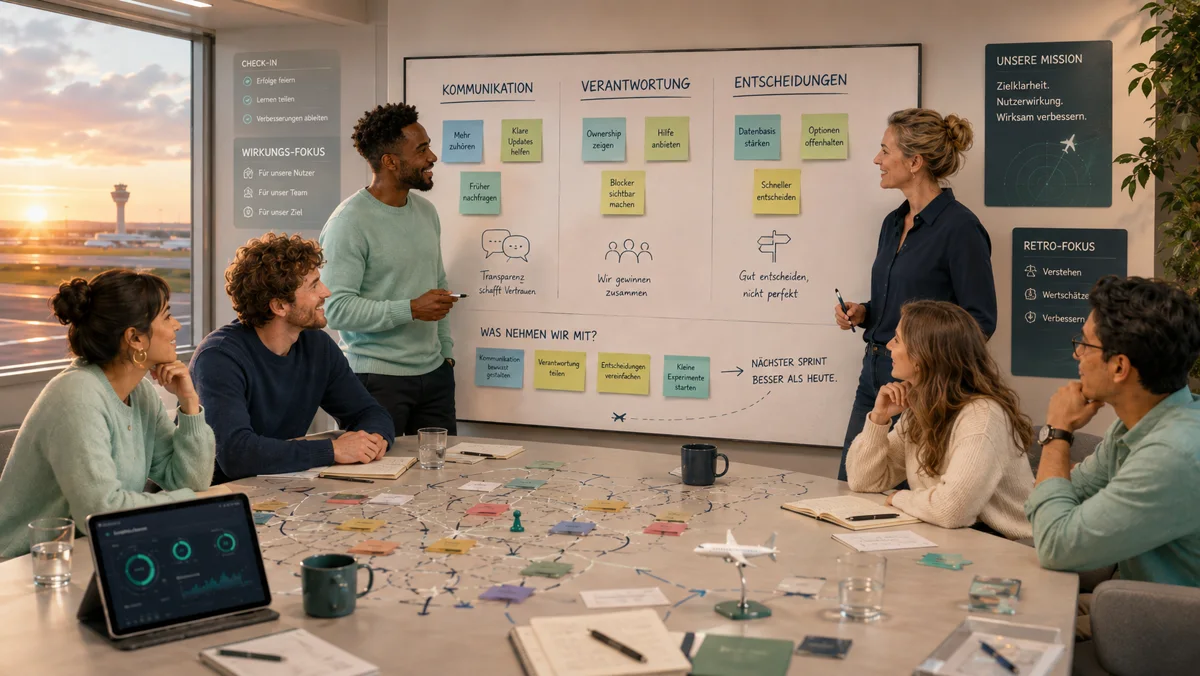
A different kind of retrospective: how the FlightRoom sets new impulses
 AI
AITips for your team event:
 AI
AI- Use the FlightRoom for example as an ice-breaker in retrospectives, to reflect together on how you communicate and decide under pressure.
- Play it before a planning session, if you feel your coordination has been falling short lately.
- After the game, run a short meta-reflection round: who had which information? Who took responsibility? What helped us find a solution together?
- During the game, watch for typical Scrum role patterns: who takes responsibility like a Product Owner? Who provides structure like a Scrum Master? Who acts like a cross-functional development team?
- Use the game to build empathy for other roles in the team — that too is a key to better team dynamics day to day.
The FlightRoom takes little preparation and is an easily accessible team event for agile teams, one that achieves more than many meetings. Give it a try — and if you notice how much potential is in it, get in touch for the next level.
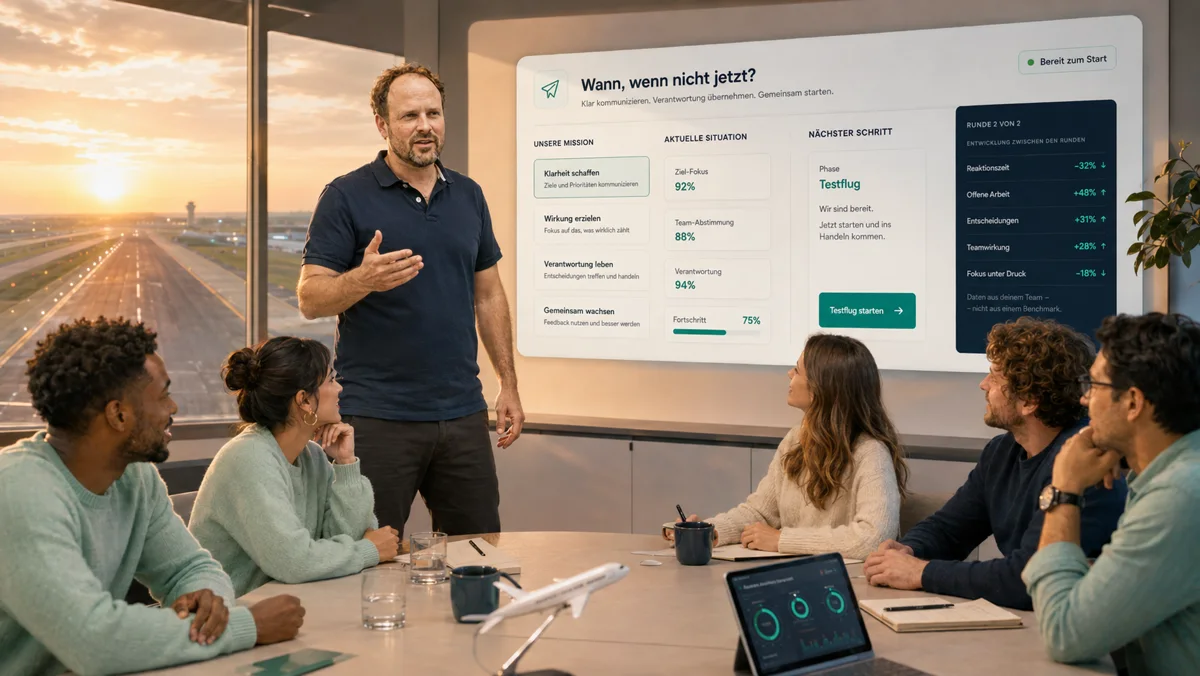
If not now, when?
 AI
AIIf you want your team not only to work together better but also to decide more boldly, communicate more clearly and take real responsibility, then now is the right moment for a test flight.More about the FlightRoom for remote agile teams