Team & agility
Flying, arguing, crashing – a game loop for shared team goals and better communication

 AI
AIKnow the feeling when a well-meaning colleague unknowingly destroys your work?
Misunderstandings rain down on us every day and cost time, money and above all trust.
And that is despite our best efforts in the standup to pour out our innermost thoughts and mention every last detail we finished before knocking off for a beer.
Seriously though: beer or no beer, plenty of well-drilled teams put in an enormous day's work. And somehow it still is not enough?
Anyone working in an agile setting has left classic waterfall project management behind, but knows those meticulous story point estimates that are already sounding the alarm on day two of the build.
What story points do not tell you
 AI
AIMy own team was no exception. Every other day my committed crew of software developers, UX designers and a product owner gathered to estimate one or two User Stories .
User stories are essentially a bundle of needs given a name in a particular format. Rather than estimating effort, agile teams like to estimate complexity — in story points.
What those story points are supposed to do is make the future more predictable, so you can judge how long something will take.
What nobody has in view on estimation day is what happens when misunderstandings survive and only surface during the build — usually with something close to physical pain.
Plain communication failures carry an expensive interest charge on top of the story points.
A change of air, or living with the interest charge?
 AI
AIIn any case, my team was there again, and I sat in the office late one evening brooding desperately over a fix for the latest delays. After roughly twenty laps of the room, it finally clicked.
Communication inside the team was the cause — at least one cause. Something deep down was pushing me, and I had the drive to turn my team into a top team.
Without good, ideally outstanding communication we would fail again. That stung most when I remembered my last holiday, where a great deal went wrong.
So training was needed. The Flight Room idea was born. Carrying on with that dead weight was not an option, so I set aside a whole day for it.
 AI
AIA team day was overdue anyway. Time for a change of air.
What a game loop has to do with top teams
 AI
AIIt was going to be a role-playing game, with a pilot in the lead. Because in aviation, unreliable communication is quite literally fatal.
Instead of puzzling over project plans any longer, I sat down and built the cockpit for the simulation — back then I was still a fairly decent software developer.
I did not know it at the time, but what I was designing was a game loop for the role play. A game loop is the core sequence of play that keeps repeating. In a typical computer game it runs something like fight->loot->explore->fight.
This was about communication and, first of all, about being aware what a difference it makes at all. We were engineers, let us not forget.
Flying, arguing, crashing
 AI
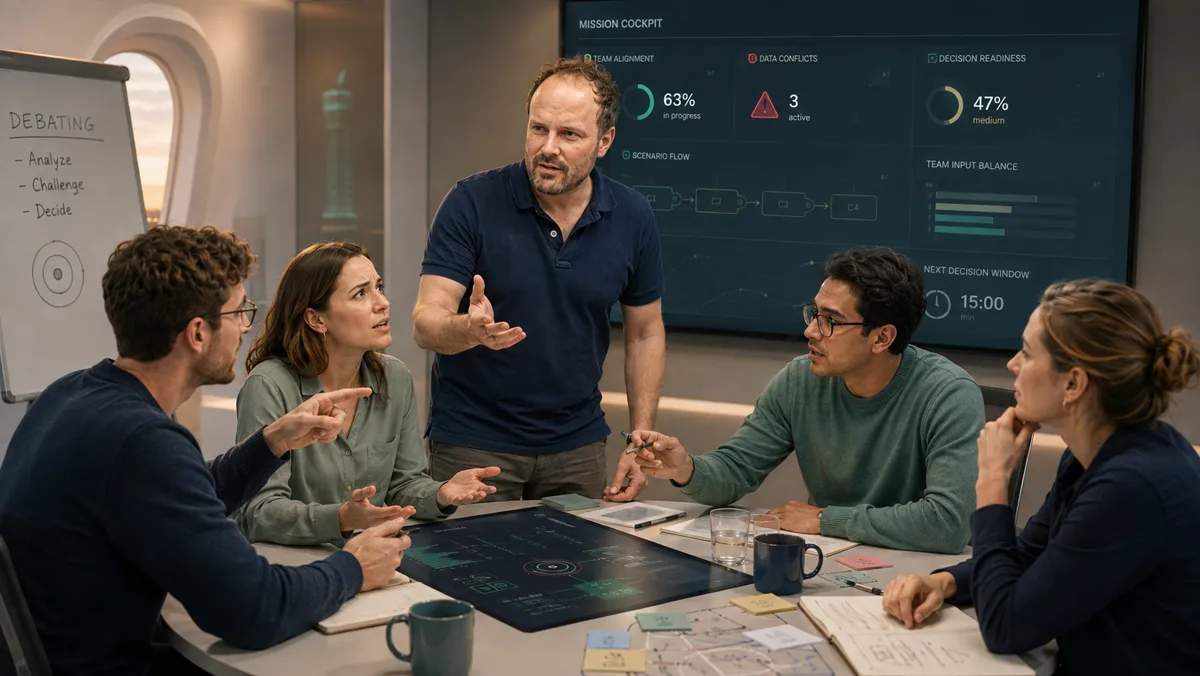
AIThe game loop did not look quite like that, but nearly: flying stands for playing your part — pilot, co-pilot, engineer, tower, cabin crew and so on. Then a message carries a problem inside it, and that leads to a hopefully friendly kind of argument — who is right?
 AI
AIAnd finally the crash. That was the fatal ending, but before it there had to be a steady supply of new problems: false confidence, contradictory readings, conflicts over authority — whatever your heart desires. All of it under time pressure.
 AI
AIHere is the short version: the game loop worked. The team focused on the shared goal — getting the flight back on a safe course — and stumbled and argued for all it was worth.
A team day that worked
 AI
AIOnce everything was ready — the preparation documents and the cockpit for the simulation — we could set off. I loaded it all onto a tablet, two of them in fact, and we marched into the woods.
Equipped with ropes, which had nothing to do with the flight simulator, we found a quiet spot for the first round.
The second came later, once we were back and had eaten, in our own meeting room. The cockpit up on the big screen so everyone could see it.
I have since put the instructions and the cockpit online: The Flight Room
The cockpit tool with the simulations is free for anyone to use, incidentally.
 AI
AIWhatever else you take from this article, please take this:
Communication decides.
And sometimes it decides life and death.