Gamification & learning
Gamification & behavioural design: why this combination is so effective

 AI
AIWhy this subject fascinates me
 AI
AIEvery day I see how decisive it is to understand user behaviour and to guide it. Two approaches fascinate me above all: Behavioral Design — applying psychological insight to product design — and gamification — putting game-typical mechanics into non-game contexts.
As a user of apps like Duolingo or MyFitnessPal I noticed early how motivation, rewards and routines shape everyday life. Research confirms that gamification raises productivity at work (90% of employees say they are more motivated by it) and that well-designed Behavioral Design massively increases user retention.
Those figures showed me one thing: whoever combines these two concepts finds an unspeakably powerful strategy for raising engagement, Retention and ultimately conversion in digital products.
What Behavioral Design is — and why it works
 AI
AIBehavioral Design means applying insights from psychology and behavioural science to products in order to lead users towards particular actions. It is not only about usability but about building products profitably in the users' interest — by taking habits and cognitive shortcuts (heuristics) into account. The core principles are, for example:
-
Nudges: small, subtle hints or presets that make it easier for users to take the desired decisions.
-
Heuristics and biases: deliberately using mental shortcuts (e.g. social proof, default options) to steer behaviour predictably.
-
Feedback and reward: immediate responses and reinforcers (e.g. success messages or points) that confirm the desired behaviour.
-
Personalisation: adapting to individual user needs in order to raise relevance and attachment.
The effect of these principles rests on the fact that people often do not act purely rationally. Rather, our brain responds to system-1 triggers (emotional, automatic stimuli): a well-placed habit cue (e.g. a push message at 8 in the morning) can therefore be enormously motivating.
Introductory studies show that Behavioral Design can make even good-looking apps more convincing still. Applied properly it can turn a "good product into a great one" that holds attention, guides decisions and builds long-term behaviour.
Established frameworks such as BJ Fogg's Behavior Model (motivation + ability + prompt) and Nir Eyal's Hook model (trigger → action → reward → investment) show the same structure: first a trigger is set, then comes a simple action and finally a reward that reinforces the loop.
Why gamification is the perfect counterpart
 AI
AIGamification picks up exactly at this point: it uses game mechanics to motivate and reward behaviour. As one specialist article aptly puts it, gamification is "a form of Behavioral Design" that deliberately addresses the predictable irrationalities of our brain.
Through points, badges, levels and leaderboards it speaks to the reward centres and creates flow experiences. That is how banal activities suddenly become gripping. Gamification mechanics include:
-
Points and badges: visible successes for concrete actions (e.g. a 7-day streak, levelling up).
-
Progress bars and charts: clear visualisation of goals and progress (e.g. calorie or learning progress).
-
Leaderboards & competition: comparing yourself with others creates social drive (e.g. the Duolingo league system).
-
Challenges and quests: structured tasks or weekly challenges that keep things varied (e.g. fitness challenges in apps).
-
Social elements: teams or groups in which users support one another — combined with leaderboards or co-op quests.
Thanks to such elements engagement rises sharply. Industry statistics show that gamification can raise user engagement by 100–150% compared with non-gamified environments. MyFitnessPal, for example, uses progress displays, streaks and social challenges to achieve exactly this effect.
Studies report that well-integrated gamification "raises engagement, improves retention and ultimately helps users reach their goals". With digital products such as apps or SaaS in particular this potential can be exploited in full: an analysis of the SaaS sector speaks of gamification as a "powerful motivational force beyond mere fun: reward and recognition".
Why the two together are especially strong (synergies)
 AI
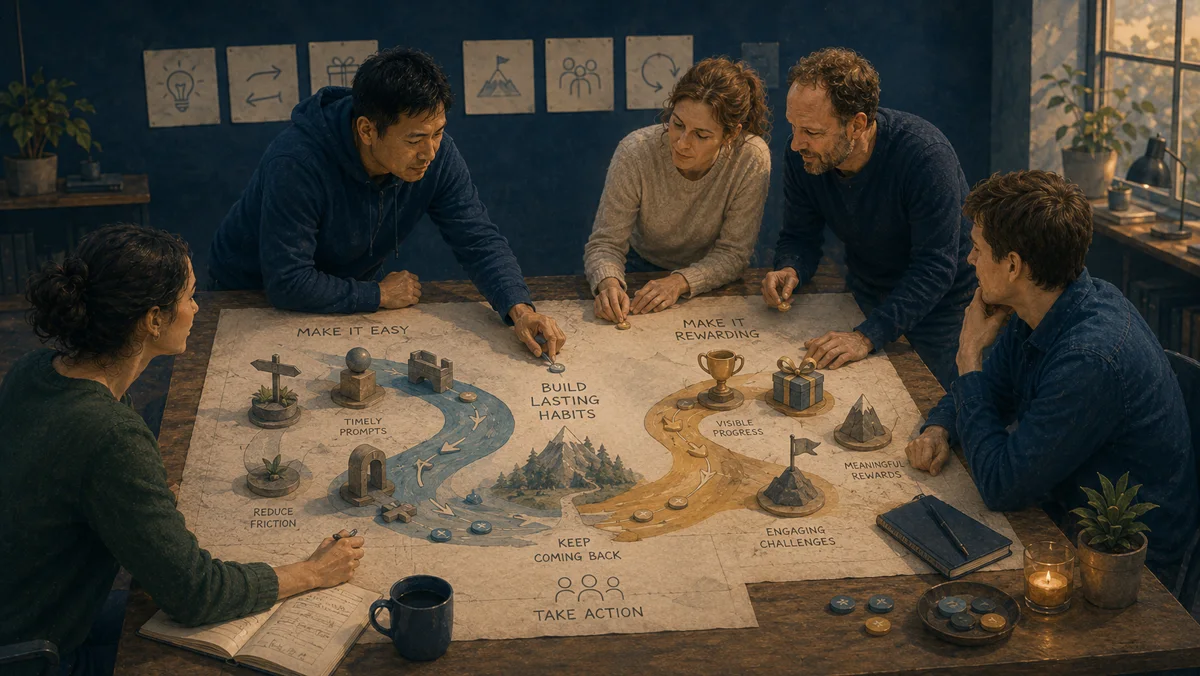
AIThe real strength lies in using Behavioral Design and gamification together . Nudges and cues make sure users take the first step; gamification delivers direct feedback and incentives to keep going.
A strategy paper for start-ups puts it precisely: "Combined, gamification and nudging can create a strong synergy that greatly increases user engagement" (source: fastercapital.com).
You can picture it as a loop: a trigger (e.g. a push notification) sends users to the app, where progress and rewards already await them (points, friendly success sounds). This positive feedback acts like an extra habit cue, reinforcing the new habit and firing up intrinsic motivation.
At the same time Behavioral Design checks which mechanic fits which moment — a badge as a small motivational push, say, when interest is fading.
To my mind that creates a perfect harmony: behavioural principles (e.g. Fogg's MAP model) provide the right conditions, while playful elements keep the tension alive. The combination can work over long stretches of time: users stay engaged and loyal.
A practical example: Duolingo couples daily learning goals with playful rewards (streaks, XP, leaderboards). A gamified nudge like this ("exercise of the day") gets people to learn every day, which has led to a measurable drop in churn.
Examples and studies that back it up
 AI
AI-
Duolingo (language-learning app): the world leader, with around 19 million daily active users in 2023. The app has run hundreds of experiments to raise retention with gamification. Even small changes had large effects: moving registration to after the first lesson raised next-day retention by 20%. Introducing a "streak wager" (where users can risk a small stake) raised 14-day retention by 14%. Conventional mechanics paid off too: personalised push messages featuring the well-known Duolingo mascot led to 5% more daily active users. According to Duolingo product manager Zan Gilani, gamification is the app's recipe for success. One study even found that 80% of learners enjoy Duolingo precisely because of these gamified elements. Within a few years Duolingo tripled its core metrics — from user numbers to revenue — which shows the gigantic potential (2017–2020: revenue up from $13 million to $161 million).
-
MyFitnessPal (fitness and nutrition app): uses a wide range of gamification features to motivate users. There are running progress displays (the calorie counter as a progress bar), badges for training and nutrition successes, daily streaks for continuous tracking and regular challenges (e.g. shared step goals). An expert analysis writes that MyFitnessPal shows how integrated gamification elements drive engagement and clearly improve retention. Streak displays and rewards lead directly to users opening the app more regularly and dropping out less. In practice the advice is to fit such mechanics to the user's goals — a nutrition focus, for instance, may work better with protein-based challenges than with generic step challenges.
-
Fabulous (habit-building app): another hands-on case from the health field. The founders developed the app in Duke's Behavioral Economics Lab. With behaviourally grounded "tiny habits" (small actions that can be repeated daily) Fabulous quickly found success in self-care. The app won several design awards and recorded over 297,000 monthly downloads with growth of more than 40% a month. Here too the makers combine nudges (e.g. personalised daily coaching messages) with subtle gamification elements (step-by-step plans, motivating graphics). The result: users stay with it and slowly build new routines into their everyday life — confirmed by the rapidly rising user base.
-
Academic studies: the empirical research underlines the effect. A recent paper (JMIR Serious Games, 2024) showed that an optimised gamification system (with mathematically calculated point rewards) produced significantly more of the target behaviour than an app without gamification. Put simply: participants succeeded in establishing their drinking habit more often with the game system. The authors write: "Optimised gamification can make digital behaviour change more effective" (source: pmc.ncbi.nlm.nih.gov. Similar findings run across numerous disciplines — from healthcare to education: gamification is often what makes lasting change possible in the first place, by awarding points for the desired behaviour.
Taken together, these examples and studies show impressively that gamification and Behavioral Design can go hand in hand to raise motivation, engagement and loyalty.
What companies and product managers can take from this
 AI
AIGiven these findings, teams can take clear steps to get the maximum benefit:
-
Define the target behaviour clearly: start by defining which user action you want to encourage (e.g. logging in daily, working through features, upgrading to the premium version). Only then can fitting nudges and rewards be developed.
-
Build in nudges and habit cues: set sensible triggers: onboarding help, sensible defaults, clear guidance or regular (friendly) reminders. Even a simple hack like Duolingo's (lesson first, then registration) can raise one-day retention by 20%. Use push messages with a positive tone and personal address — that lifts responses (e.g. +5% DAU from the Duolingo mascot messages).
-
Integrate gamification mechanics: choose elements that fit the psychology of the product. Examples are progress bars, points, badges, levels, streaks, challenges, leaderboards or rewards for viral behaviour (sharing, invitations). Make sure the rewards are relevant and valuable. Small gifts, exclusive content or status symbols can be powerful incentives. What matters is tying the mechanics to the users' core needs (e.g. status in social media, self-worth through badges).
-
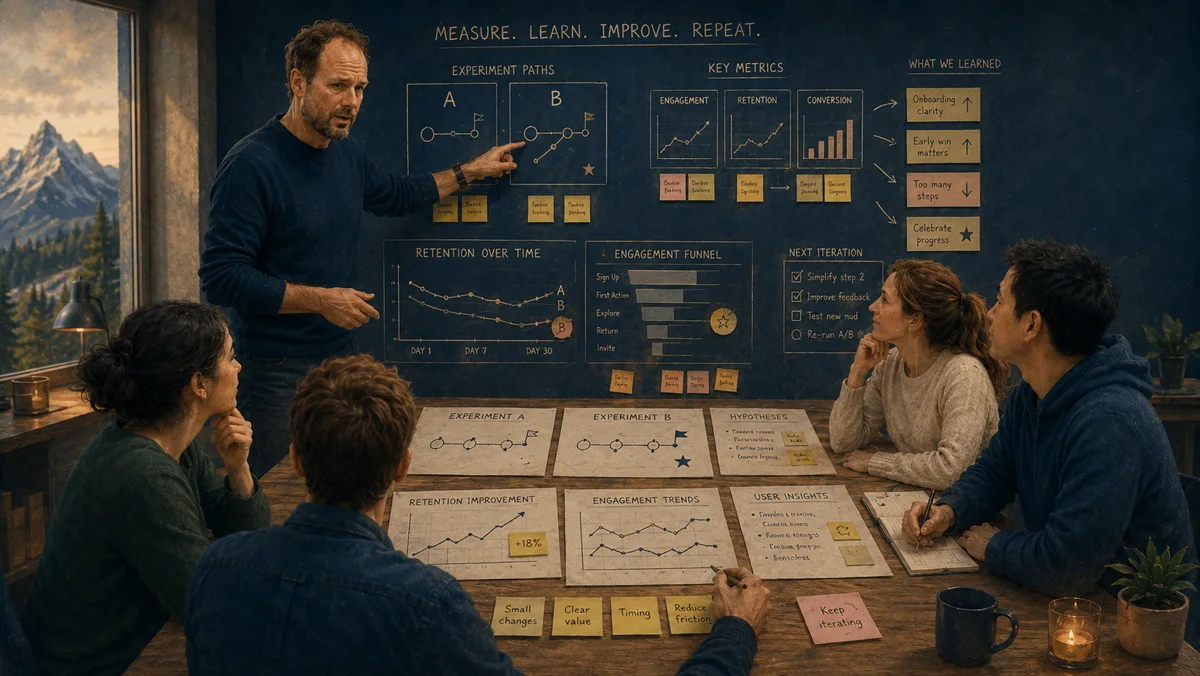
Measure metrics & iterate: run A/B tests (as many gamification professionals do) and track engagement and retention rates closely. Typical KPIs are DAU/MAU (user engagement), retention after 1, 7 and 30 days, and conversion rates (e.g. from free to paid). Milestones reached, such as retention improved by X% or conversion rates by Y%, should be documented. Analyse regularly and improve — as Duolingo does, continuously testing new mechanics to make the app stickier.
-
Watch the ethics and the user benefit: gamification and nudges should never be manipulative. Be transparent about why you use particular elements, and make sure they bring users real value. Good practice is to tie rewards to goals the users chose themselves (e.g. better fitness, language skills, personal challenges) rather than keeping them "captive" for no reason. Because a clever combination of Behavioral Design and gamification works best when it is aimed at what the user gains.
In closing — my appeal
 AI
AII am firmly convinced: companies that combine Behavioral Design and gamification cleverlycan build digital products that are not merely "useful" but genuinely fun, and that become a habit.
In a world full of apps and services that is a decisive competitive advantage. So: experiment with nudges, habit triggers and playful incentives, but always in the service of the user. Measure carefully what works, and adapt it to the needs of your target group.
Be ready to use small psychological levers — they can have an enormous effect (as studies and Duolingo show impressively). It is worth it: the combination of Behavioral Design and gamification will noticeably raise your retention and conversion, and turn a good digital product into a great one.
Let's get to it!