Gamification & learning
How an old-fashioned learning tool can become a digital super tool

Do you still remember your school days?
The one study aid you hated but which somehow worked in the end?
Maybe it was index cards, gap-fill exercises or those odd "mind maps" nobody could ever properly explain to you.
What if those dusty tools are exactly where the potential sits for an innovative digital product today — one that students actually enjoy and stick with?
Sounds mad? Perhaps. But sometimes the next breakthrough is lying exactly where nobody is looking any more.
Why "old" does not automatically mean "obsolete"
Digital business models demand clear benefit and strong positioning.
And that is where an often overlooked option comes in: what if a long-serving, seemingly retired study aid could shine as a new digital specialist tool?
Rather than reinventing the wheel, it can make more sense to work with the tools that disappeared from the teaching kit long ago — and give them a surprising upgrade.
The underrated star: flashcards
The Munich EdTech startup StudySmarter.
In 2012 studies still showed that flashcards were fairly unpopular with school and university students — only 11 % used them regularly, and many found them boring or too time-consuming. And yet:
In 2020 an EEG study (Kardan et al.) demonstrated that exactly this cognitive effort strengthens long-term memory.
Flashcards work. They activate the brain. But only if they actually get used.
StudySmarter saw the potential and digitised flashcards — with gamification, progress tracking and social learning.
Suddenly the formerly dull study aid was a clever feature. And it worked: over 100 employees, funding in the millions, reach across Europe.
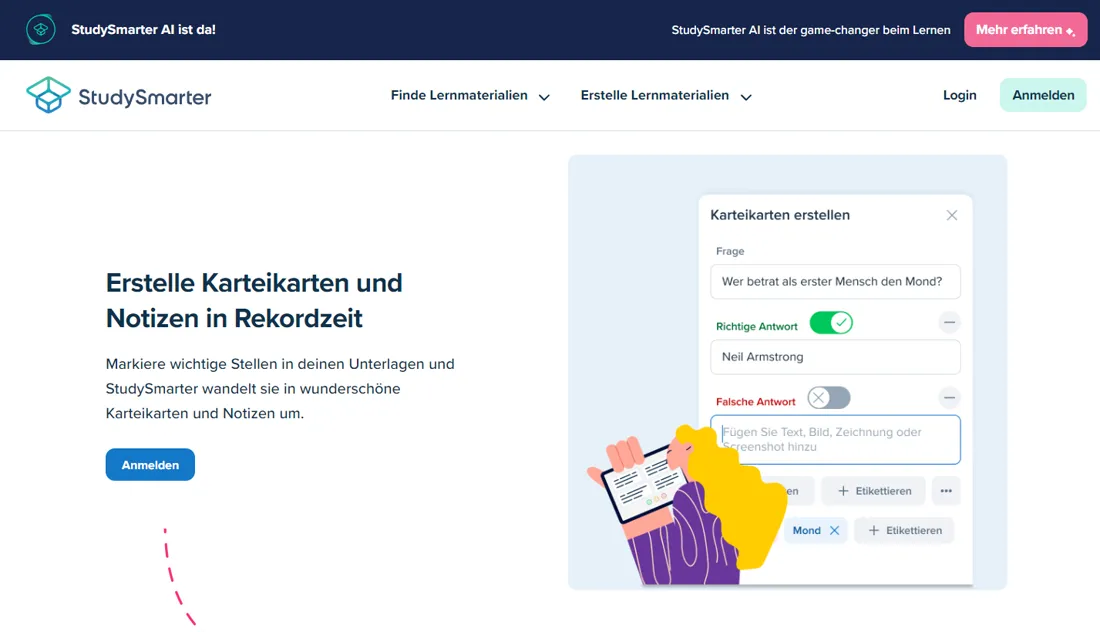
Old tool, new mechanic
What does that mean for building digital learning products?
Quite simply: every product may be sitting on an overlooked feature — an "annoying" tool that smart development can turn into a secret weapon.
The key is to rethink it
- Which learning methods are dated but effective?
- Which were forgotten because they were manual or unwieldy?
- Which could UX, design or smart logic make attractive again?
Maybe it is the classic gap-fill exercise, rethought with adaptive hints. Maybe an essay construction kit that gives real feedback. Maybe a maths trainer that explains mistakes the way a good teacher would.
Here is the trick: you do not need a new concept — you need a new mechanic.
Something to think about: product design with a brain
In digital education in particular, features have to fascinate. Not through surface polish, but through the feeling: "this genuinely helps me."
Which means: do not just build functions, create relevance.
And that is exactly where the big opportunity lies:
A study aid nobody has bothered with can, thought through properly, become your platform's signature feature.
Your task (warm-up challenge)
🧠 Take 5–10 minutes and work through these three questions. Write your ideas down — or better still, say them out loud.
- Which study aids do you personally prefer? (easy)
- Which study aids do you know of that almost nobody uses any more? (medium)
- Which of them is best suited to being rethought digitally — as a genuinely interesting specialist tool? (hard)
Pick one question and note down your thoughts. The start of your next successful feature may already be in there.
And finally: one question remains
What if the most boring study aid of your school days became the most valuable feature of your product?
The tools are there. So is the research. All that is missing is your angle.