Product & growth
How to break out of stagnating MRR as a solo tech founder

Plenty of SaaS products fail not on features but because users do not know how they are supposed to behave inside them.
Pen-and-paper game masters have been solving exactly that problem for decades: they build worlds in which decisions are safe, sensible and obvious.
This article shows why that way of thinking makes your product clearer, more trustworthy and therefore easier to buy.
When a world has no rules, people play defensively
Every good game master knows the moment.The party is at the table, the map is out, there are plenty of options and still nothing happens. Nobody is unmotivated. Nobody is overwhelmed. But everyone is waiting.
An experienced game master knows the problem is not with the players.
Nor is it the quest.
It is that the world itself is not yet defined clearly enough.
In that sense game masters are not storytellers but product designers.
The world is their product.
And their job is not to steer the players but to build a world in which acting becomes the obvious thing to do.
Because before a player makes a decision, they unconsciously check something else: how does this world actually work?
- Are risks allowed, or are they fatal?
- Are mistakes part of the story, or are they punished?
- Does boldness get rewarded, or is caution the only safe strategy?
As long as those questions stay unanswered, players behave rationally.
They hedge.
They test carefully.
They act defensively.
Not because they play badly, but because the world has not yet allowed them to play well.
The same thing is happening inside your product
As a solo tech founder you are in a similar role.
You have built a world: your app. You know every corner, every rule, every shortcut. To you it is obvious what makes sense and what does not.
For the user it is different.
They step into your product like a new game world — without a rulebook.
They do not know which decisions are safe here.
They do not know what counts as playing well.
So they behave the way players always do when they are unsure: cautiously.
Caution feels rational.
But caution does not pay.
People act on their assumptions about the world, not on the truth
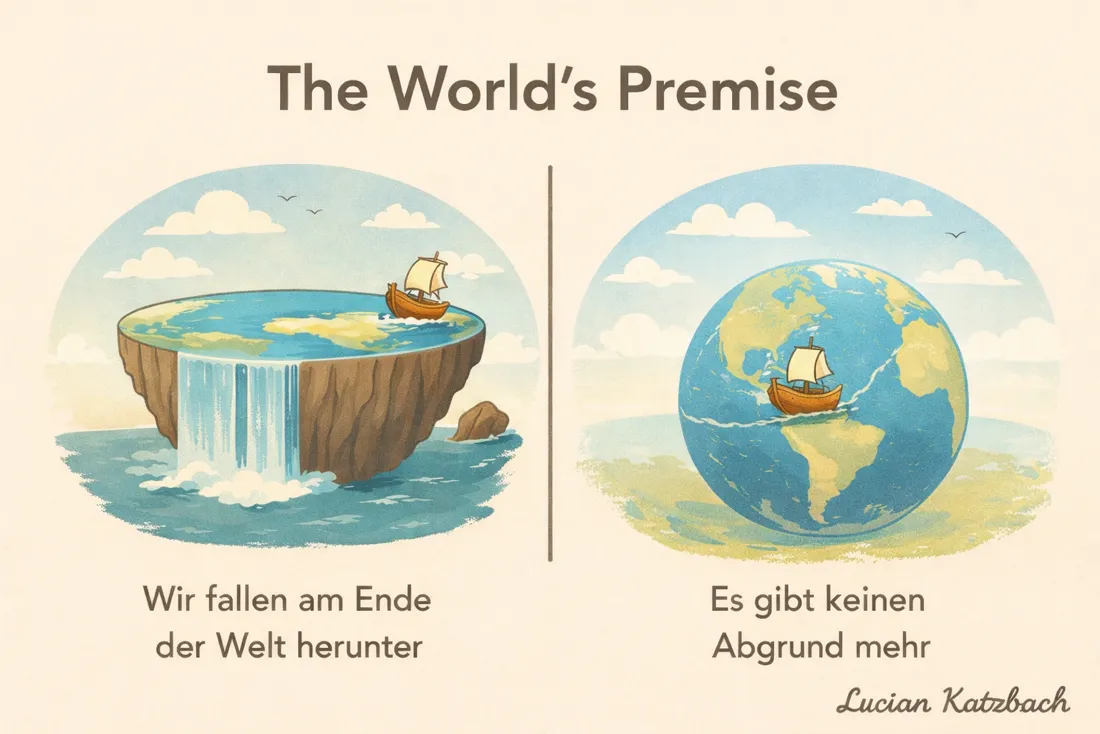
People once believed the earth was flat.The abyss waited at the edge. So nobody sailed further than felt safe.
Today we know the earth is a sphere.
No edge. No abyss. Moving feels permitted.
The world itself did not change.
Only the model by which it gets judged.
As a game master this is intuitively obvious:
if players believe a mistake will throw them out of the game, they play slowly.
If they know mistakes are part of the story, they play boldly.
Your SaaS sets rules too — whether you mean to or not
Every product communicates, without saying so,- what counts as right here
- what counts as a mistake
- and how harshly missteps are punished
If you do not set those rules clearly, users fill the gaps themselves.
And they almost always do it pessimistically.
They assume that:
- a wrong click could do damage
- decisions have consequences
- holding back is safer than moving forward
Not because they dislike your product.
But because their brain wants to avoid risk while the logic of the world is unclear.
Daniel Kahneman describes exactly this state:
when rules are missing, the brain switches from fast, playful action to effortful deliberation. Decisions get hard. Movement stalls.
As a game master you would never allow this
No good DM would say:"Just do whatever, you can do anything."
They would say:
- In this world, these things work.
- These paths do not exist.
- This is how decisions get made here.
Not to control, but to make the world playable.
Steve Jobs understood exactly this.
He built products like game worlds with clear physics. Nobody had to explain them, because you could feel how they wanted to be played.
The quiet loss goes on for as long as the world stays undefined
As long as your product conveys no clear assumption about its world, here is what happens:- users stay in trial mode
- decisions get postponed
- trust never forms
That does not cost you customers immediately.
But it costs you activation, depth of use and, in the end, MRR.
Your users not acting is no accident.
It is the logical consequence of a world without clear rules.
As a game master you know it:
when the world is unclear, people do not play badly — they play cautiously.
And caution is the most expensive playing style in SaaS.
What a founder is actually responsible for
You are not responsible for making every decision for your users.But you are responsible for defining the world so that decisions can be made safely.
Sometimes no new feature is needed.
No better onboarding.
No stronger funnel.
Sometimes all it takes is a clear answer to one question:
what kind of world is this — and what is it not?
From that moment on, people start playing again.
And only those who play, pay.