Product & growth
Why learning speed is a moat nobody can copy

 AI
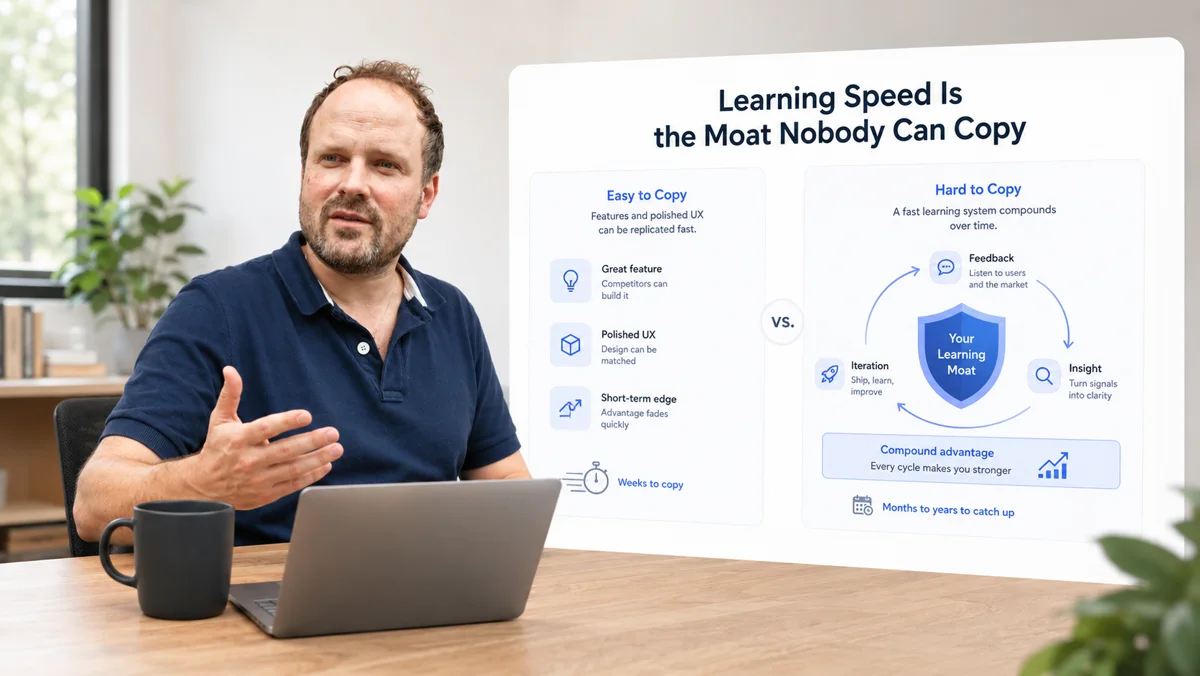
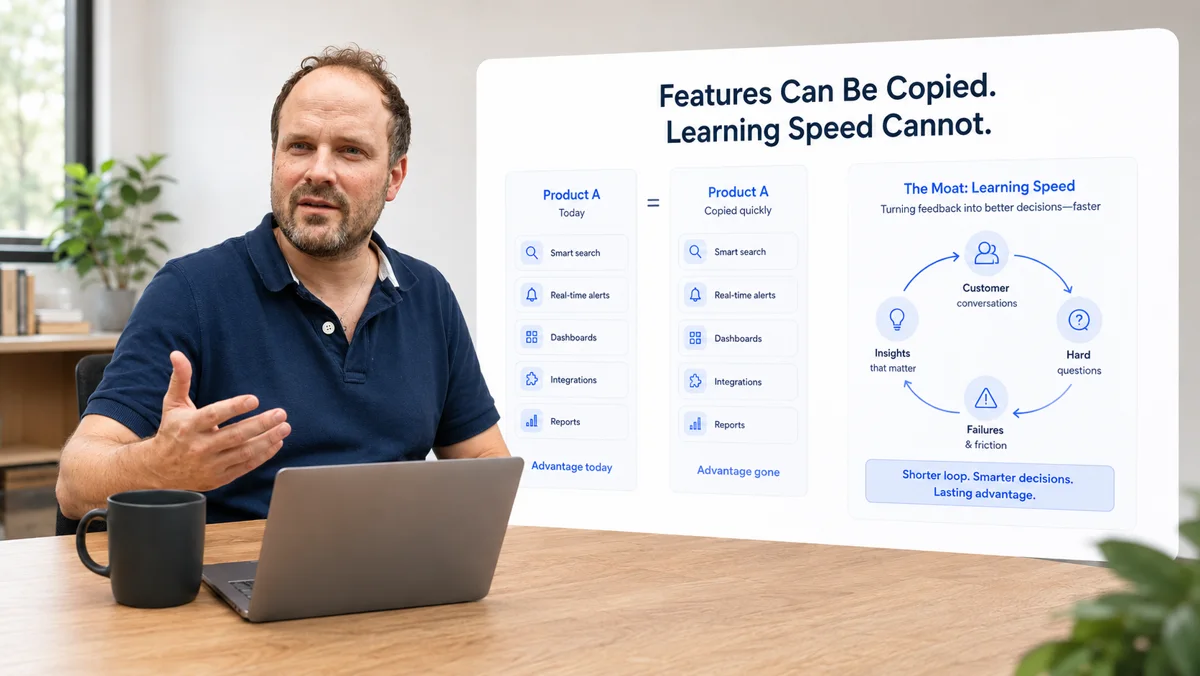
AIA product lead is no longer enough to defend a startup. Feature complexity, a polished interface, the choice of the best AI model — with AI coding tools all of that can be rebuilt in days.
What remains is a single ability no competitor can copy overnight: how fast you learn.
Not knowledge. Not experience in the sense of years in the market. Learning speed — the ability to draw the right conclusion from every customer conversation, every failure, every critical question faster than the market moves.
That sounds like a platitude at first. It is not. Let us look closely at what learning actually is, how it gets faster — and why most people start in the wrong place.
 AI
AIWhat learning typically means
 AI
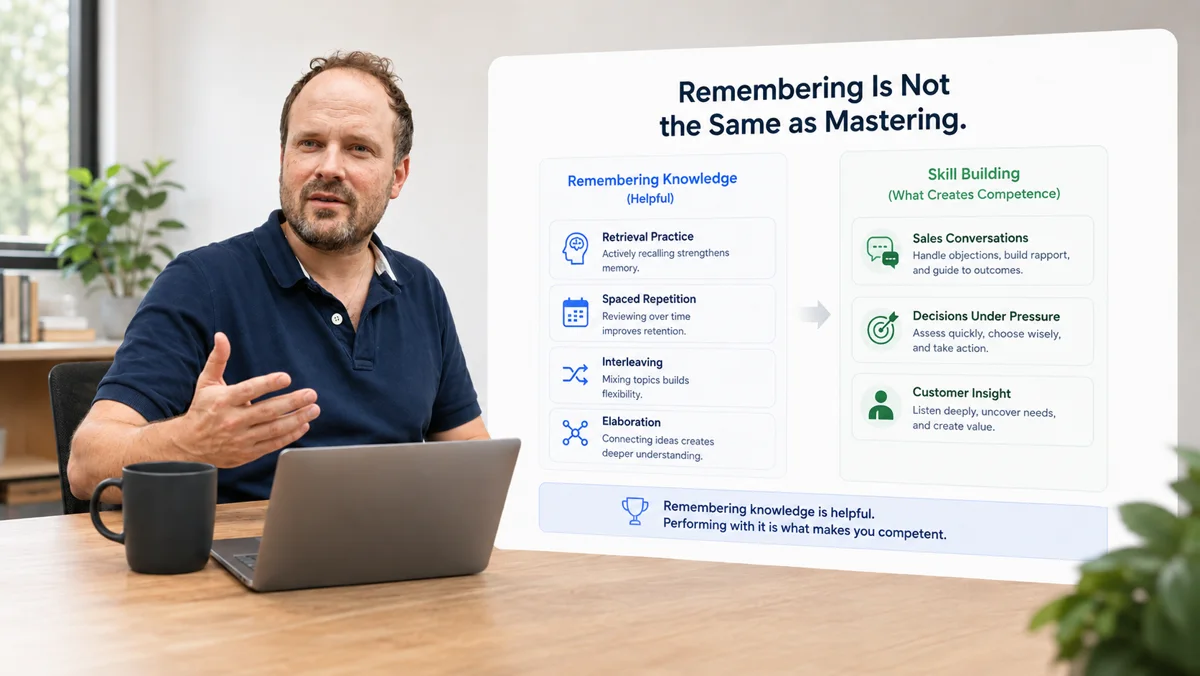
AIWhen you look for good learning methods you almost always end up with the same recommendations: retrieval practice (testing yourself instead of re-reading your notes), spaced repetition (spreading repetitions over growing intervals instead of cramming everything at once), interleaving (practising different topics mixed rather than in blocks) and elaboration (explaining concepts in your own words).
These methods are well researched and work reliably. But they solve one particular problem: they improve how well you remember something. They are tools for acquiring knowledge, not for building ability.
That is an important difference. A founder who can recall perfectly every growth strategy he has ever read is not thereby a better salesperson, nor a better decision-maker under pressure.
Memorising and real competence are two different things — and most guides mix them up.
To understand where the actual difference lies, it is worth looking at a system that has learned more about fast learning in recent years than probably any other discipline: artificial intelligence.
How AI learns
 AI
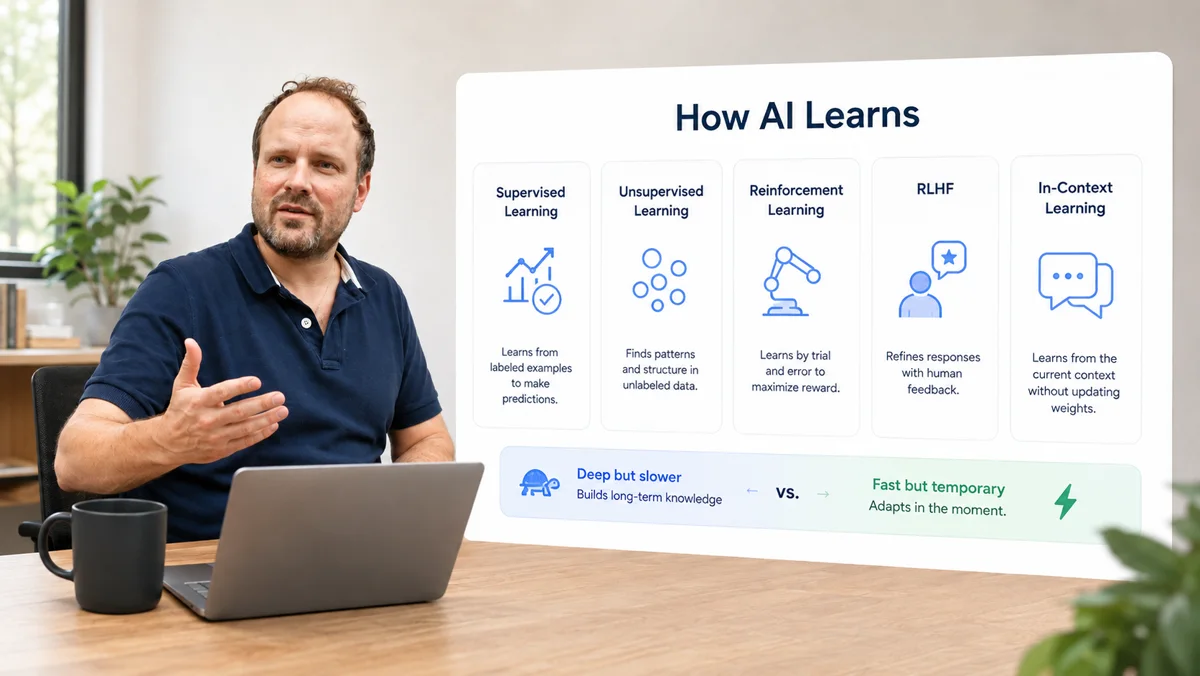
AIModern AI systems do not learn in one single way but through several fundamentally different mechanisms.
Supervised learning.
The model is shown the input and the right answer at the same time — as in spam detection. Slow but thorough: weeks to months of training, in exchange for knowledge anchored deep in the model weights.
Unsupervised learning.
The system finds patterns in unlabelled data on its own, without anybody ever telling it what is right. No direct feedback, but structure emerges that was invisible before.
Reinforcement learning.
A system interacts with an environment, tries actions out and gets reward or punishment as feedback — through trial and error, often over millions of simulated runs. Chess and Go AIs became famous for this: in the time a human needs for one tournament, they played millions of games against themselves.
RLHF (reinforcement learning from human feedback).
The standard behind modern AI assistants. People rate answers, a reward model is built from those ratings, and the actual system is trained to maximise that reward model.
In-context learning.
The fastest but most fleeting form: a language model can learn within a single conversation from examples you show it in the prompt — without a single weight in the model changing.
Seconds instead of weeks. But it vanishes as soon as the conversation ends. None of it is kept.
This is where the first important lesson lies. In-context learning feels impressive — the answer comes instantly. But it is the equivalent of cramming just before the exam: successful in the moment it is needed, completely forgotten two weeks later, because structurally nothing has changed.
The optimal way to learn: real understanding plus reinforcement learning
 AI
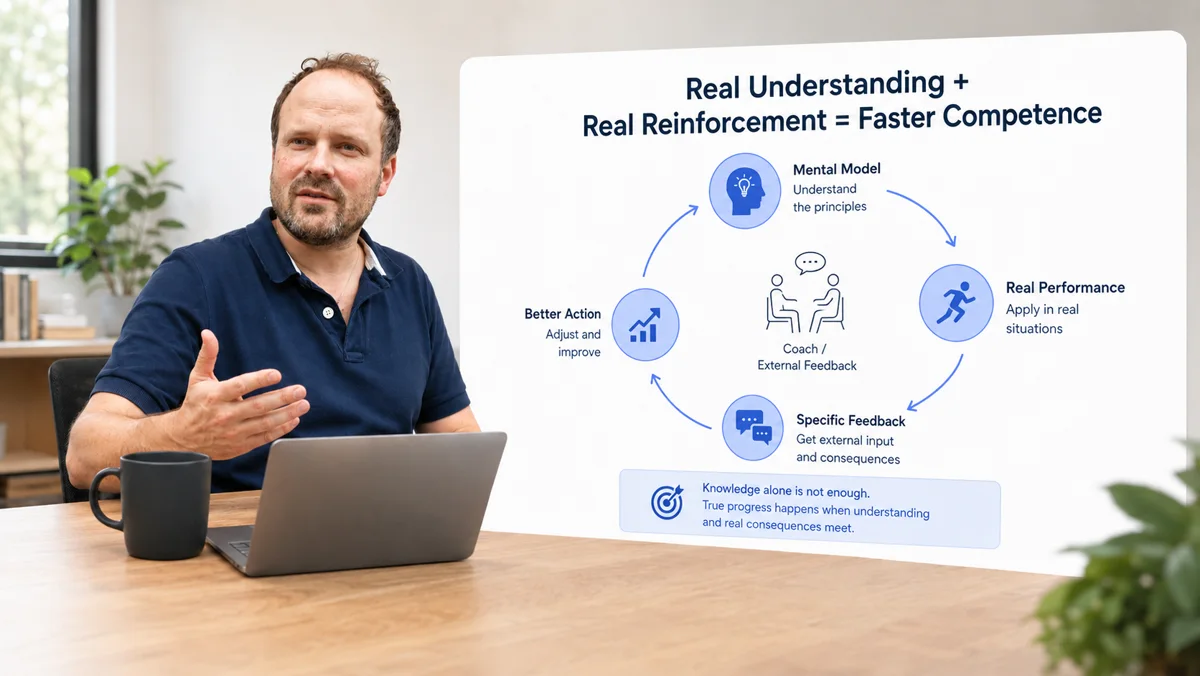
AIIf you ask what actually accelerates real competence, you end up with a formula that independent research keeps confirming: real understanding combined with real reinforcement learning.
Understanding supplies the model with which feedback can be interpreted at all. Without a mental model you know that something was wrong, but not why — the feedback evaporates.
Reinforcement — real consequence, not a simulated quiz — is the correction mechanism itself. The research on deliberate practice (K. Anders Ericsson) shows that experts do not emerge through mere repetition but through the deliberate refining of mental representations — refined inner models that allow increasingly precise control over complex actions.
That comes from repeated real performance with immediate, specific feedback, often from a coach who sees what the learner cannot yet see.
One thing matters here: the feedback has to be an honest proxy for the actual goal. Optimise for the wrong metric — marks instead of understanding, applause instead of persuasiveness, revenue instead of customer value — and reinforcement only accelerates the wrong thing.
The system then learns to game the metric, not to master reality. In AI research that is called reward hacking. In real life it is "studying for the exam, not for the subject."
What unsupervised learning does for learning speed
 AI
AIAt this point a fair question arises: if real understanding plus reinforcement is the decisive formula, what do we still need unsupervised learning for — the slowest, most aimless form of learning there is?
The answer explains why modern AI systems learn so much faster today than early reinforcement-learning systems. A chess program of the early 2000s had to start from zero and play millions of games to develop any feel for good moves at all — because it had no pretrained world model to build on.
A modern language model, by contrast, already has months of unsupervised pretraining behind it before a single reinforcement signal is applied. It already "knows" language, facts, rough causal relations. That is why comparatively few reinforcement runs are enough to produce precise behaviour — the reinforcement no longer has to start from zero, it only has to fine-tune what is already there.
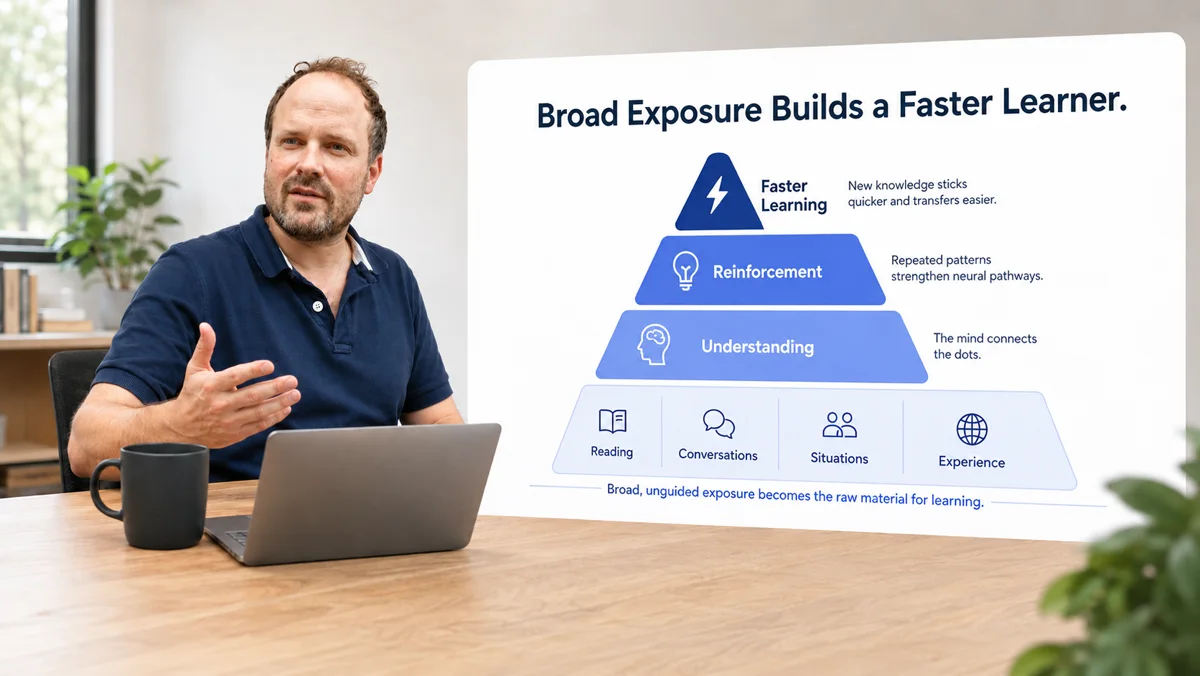
Translated to people: unsupervised exposure — broad, undirected experience with no concrete goal, much seen, much read, many situations lived through — builds the raw material out of which understanding can condense as soon as a concrete goal appears.
A founder with that foundation learns far faster from a single piece of critical feedback than somebody without it, because he does not have to start from zero just to place the feedback at all.
So the complete formula reads: an unsupervised foundation builds the raw material → real understanding condenses out of it as soon as a goal appears → reinforcement with honest feedback accelerates the fine-tuning on that foundation.
What actually blocks learning
 AI
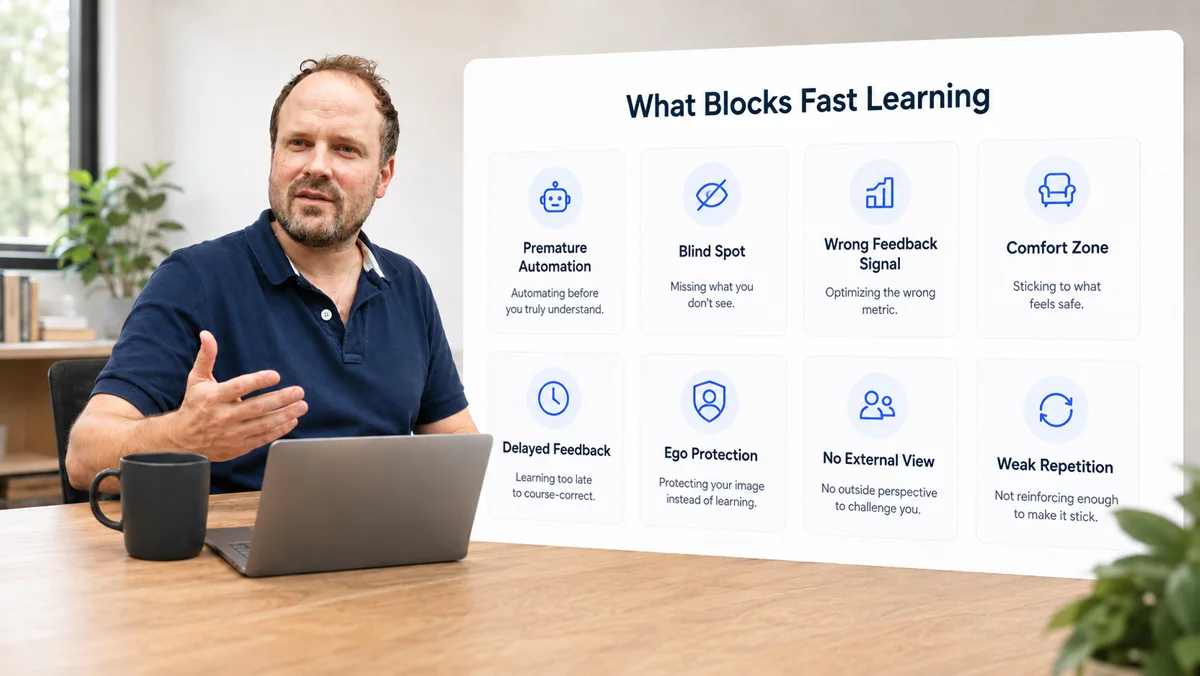
AIIf the formula is that clear, why do so few people actually learn fast? Because a set of structural obstacles and deep-seated beliefs stand precisely in the way.
Structural obstacles:
Premature automation. As soon as an ability is "good enough" it gets carried out automatically and effortlessly — and that is exactly what ends the improvement. Whoever stops practising deliberately stays on that plateau forever, however many years pass.
The blind spot. You cannot see your own next practice goal, because what limits you lies by definition outside your own perception.
The wrong feedback signal. When the metric does not represent the actual goal, you learn to serve the metric, not to master reality.
Comfort zone instead of stretch zone. Practice that is too easy feels productive but produces no progress. Practice that is too hard produces only frustration.
Missing repetition under real consequence. Knowledge heard only once changes no mental representation.
Ego protection and rationalisation. Defending your own position instead of really letting the feedback in.
Delayed or unspecific feedback. A response that comes too late or stays too vague cannot be tied to the concrete action that triggered it.
The missing outside view. Without somebody who sees from outside what you cannot see yourself, the practice stays self-chosen — and almost automatically lands back in the comfort zone.
Psychological beliefs:
"Ability is innate, not developable." The basic assumption of the fixed mindset (Carol Dweck). Whoever believes this wants to prove themselves again and again instead of learning from mistakes.
"Failing proves my limit, not my need to learn." A failure becomes a threat to your own identity instead of a normal learning experience.
"If I need help, I am not competent enough." This equation — help equals deficit — prevents feedback from being accepted at all without the self-image feeling threatened.
"I have to know the answer already, otherwise I look weak." It leads to competence being performed instead of real questions being asked.
"Feedback is a judgement on me as a person, not on my action." It makes every piece of feedback threatening instead of useful.
"I am too experienced to learn this from the ground up now." The identity of the expert prevents exactly the beginner's posture that new learning requires.
Boosters from the world of games
 AI
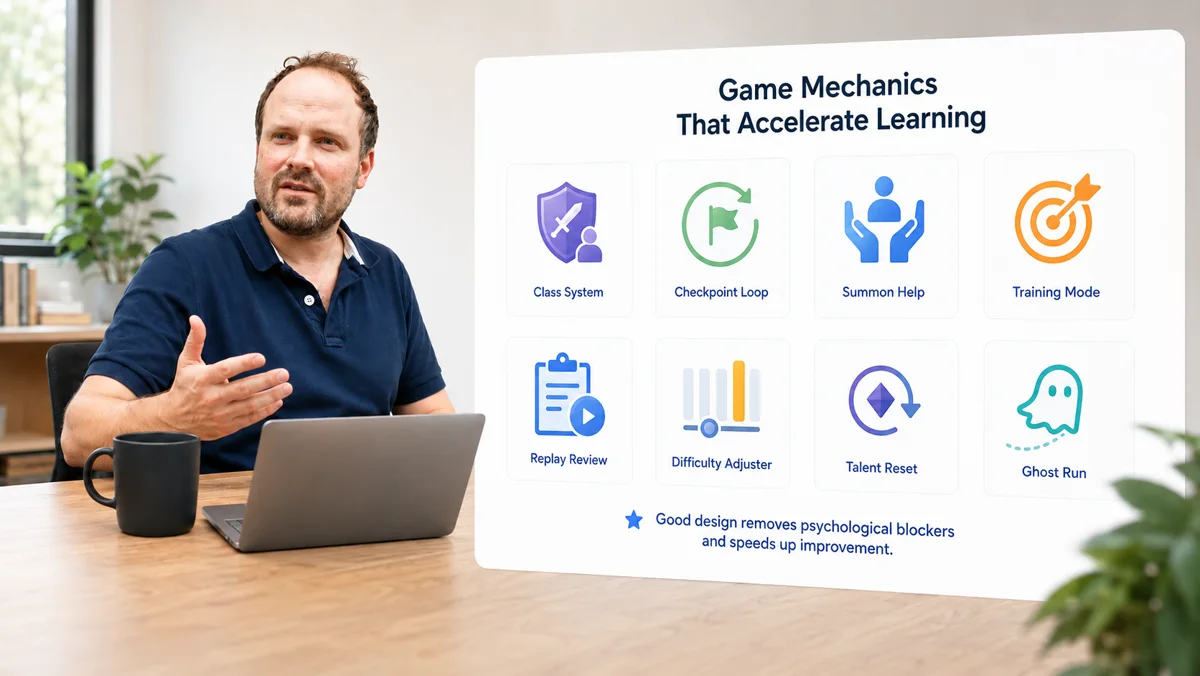
AIThe interesting part: for almost every one of these obstacles there is already a proven antidote — in games that millions of people play every day without consciously noticing the mechanics behind them.
Against "ability is innate": the job system from games like Final Fantasy Tactics — every character can master every class, purely through practice invested, with no fixed identity from birth.
Against "failing proves my limit": the souls-like checkpoint system (Dark Souls, Elden Ring). Dying is a planned, frequent part of progress — every boss fight is deliberately designed so that failing several times is the expected route to success.
Against "help = deficit": the summon sign from Dark Souls and Elden Ring. Calling for help is an actively rewarded core system, not a sign of weakness.
Against "I have to know the answer already": training mode in Street Fighter or Tekken — unlimited attempts with no consequence for your rank, built explicitly so you can try things out uncertainly before a real match counts.
Against "feedback is a judgement on me as a person": the anonymised replay in esports titles — players analyse their own matches as a pure data trace, detached from the emotional "but that is me".
Against "I am too experienced to learn this": the prestige system from Call of Duty. A player at maximum level voluntarily resets to level one in exchange for a visible badge — the game-mechanical inversion of defending status.
Against premature automation: the talent reset in Diablo or World of Warcraft. The skill tree can be redistributed at any time, which forces a deliberate departure from automated habits.
Against the blind spot: detective vision from the Batman Arkham games — a mode that shows hidden clues and weak points which remain structurally invisible to normal perception.
Against comfort zone instead of stretch zone: the dynamic difficulty adjuster from Left 4 Dead — an "AI director" that adapts the difficulty in real time to the group's current performance.
Against missing repetition under real consequence: permadeath in XCOM and most roguelikes. No reloading after mistakes — every decision gets real weight.
Against ego protection and rationalisation: the death recap in Overwatch or Valorant — it shows exactly who hit you from which direction with how much damage. The data refutes every excuse immediately.
Against delayed feedback: real-time damage numbers, as practically every modern action RPG shows them — exact, in the moment it happens, not as a vague summary afterwards.
Against the missing outside view: the ghost replay from Mario Kart or Trackmania. A visible "ghost" shows the exact ideal line of a better player at the same time as your own run — you see not only that you were slower but exactly where and why.
The proof in detail: why the summon sign works
 AI
AIThe strongest of these boosters deserves a closer look, because it shows how precisely good design can dissolve a psychological blocker — not through an appeal but through mechanics.
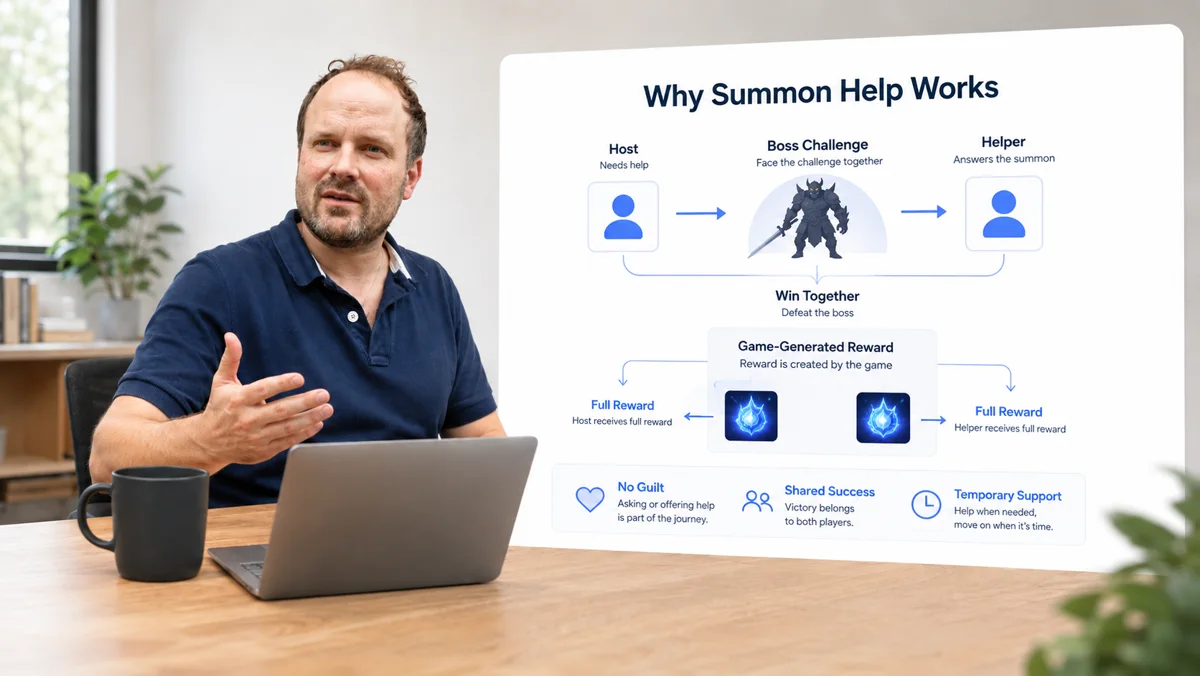
Here is how it works: a player stuck on a hard boss fight places a visible golden sign on the ground. Other players nearby can touch that sign and are pulled into the world of the person asking for help for the duration of the fight.
The enemy is fought together. If the group wins, the helper returns automatically — if the host loses, all helpers are thrown out immediately.
The decisive mechanism lies in the reward: it does not come from the host but is generated by the game itself. If the group defeats the boss together, everyone involved — host and helper at the same time — receives their own full reward.
The host gives up nothing of his own progress, and the helper does not get a share of something that would otherwise have gone to the host alone. Both benefit independently of each other, triggered by the same shared achievement.
Only if the boss is not defeated does the helper go away empty-handed — the reward is tied to shared success, not to mere participation.
Why that dissolves the belief "help = deficit" so effectively: no debt arises. Nobody has to ask what they now owe the other — a neutral, generous third party (the game) rewards both sides independently.
On top of that, the help is strictly limited in time and ends automatically after the fight. It is not a lasting admission of dependence but a one-off, clearly defined support exactly at the point where you are currently stuck.
That is the real lesson for any coaching or team system: help stops feeling like a flaw as soon as it is designed so that both sides are rewarded independently for the shared success — rather than one side "owing" something.
The point of all this
 AI
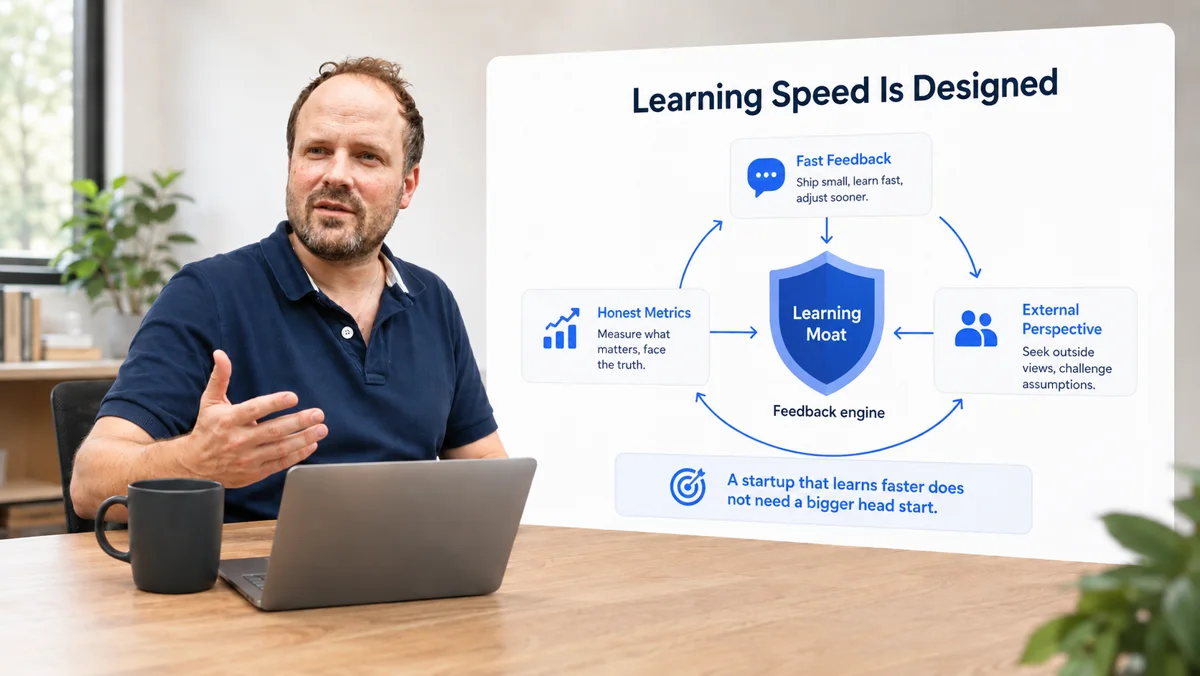
AIEvery one of these games has understood what most companies and most people have not: learning speed is not a character trait. It is the result of design — how much friction lies between a decision and its feedback, how honest the metric you steer by is, and whether somebody from outside sees what you structurally cannot see yourself.
A startup that learns faster than its competitor does not need a better head start. It needs a system that processes feedback faster, more honestly and more consistently than anyone else in the market.
This moat cannot be copied with an AI coding tool over a weekend — because it is not a feature but a habit.
— Lucian Katzbach