Product & growth
Why your product lead is no longer enough

 AI
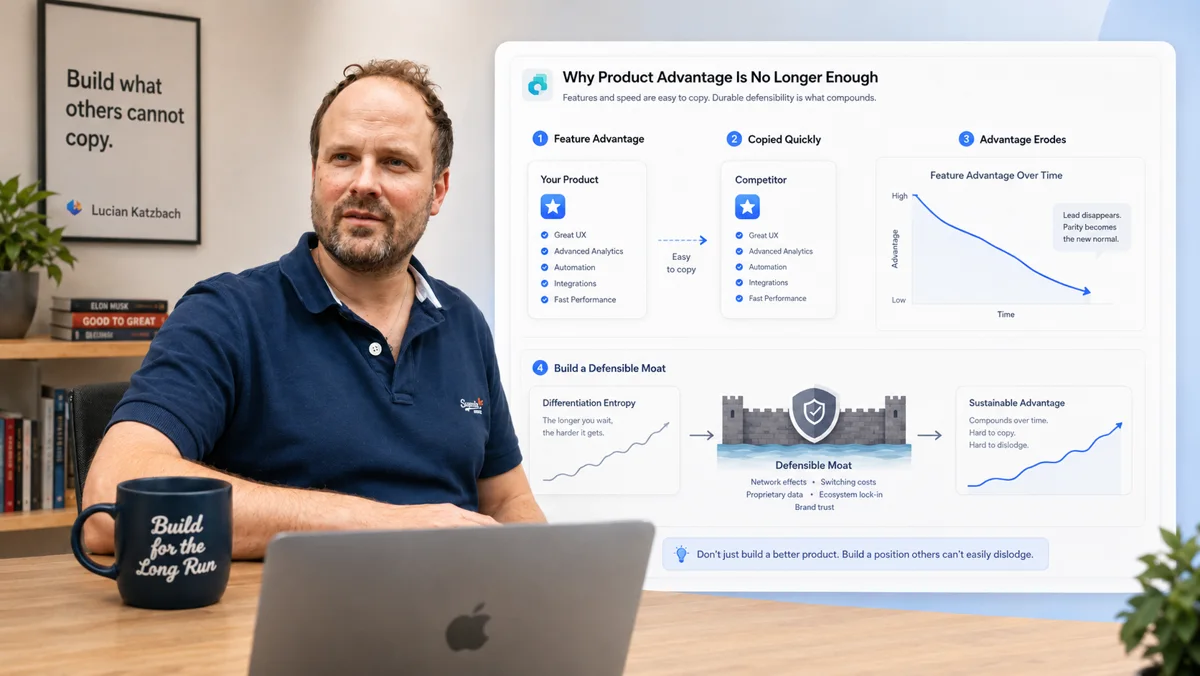
AIYou are building your startup right now. You are working on more valuable features. You are improving your user experience. You are refining your AI model. Or perhaps you are simply trying to be in the market faster than everyone else.
It feels like progress. It is not necessarily progress.
The break almost no founder sees coming
 AI
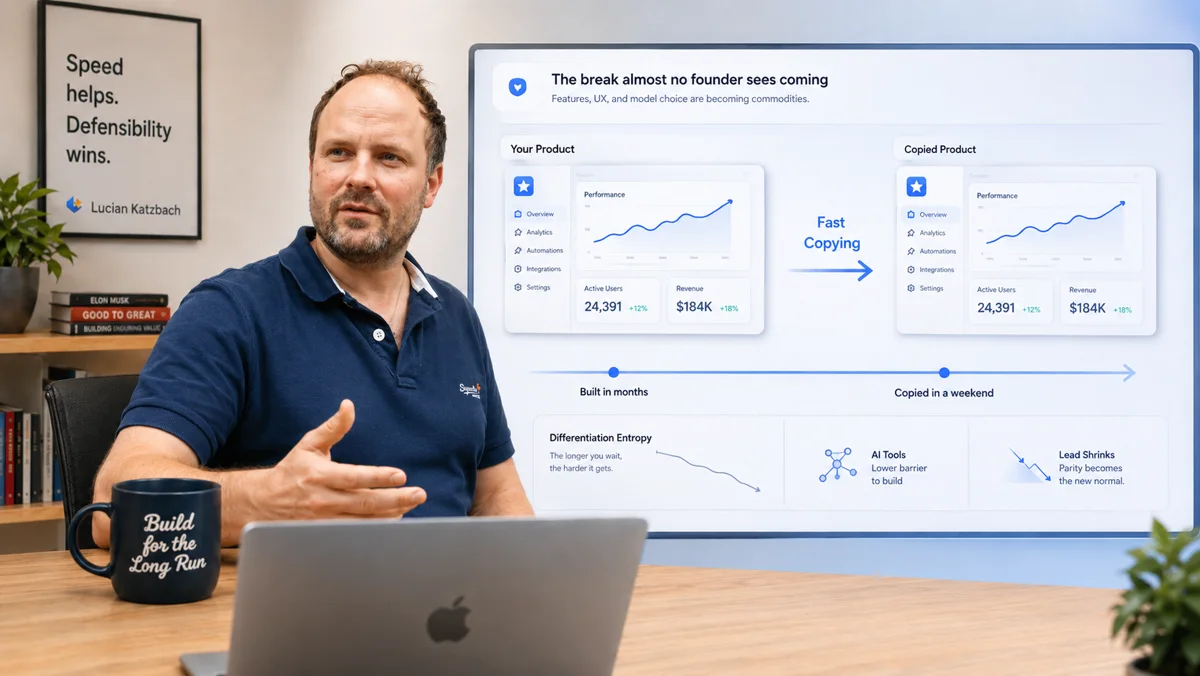
AIThree years ago that was a reasonable strategy. Building a good feature set took months. Designing a clean interface took a development team. Whoever was faster had a genuine lead.
That has shifted. AI coding tools make it possible to clone an interface in an afternoon. A competitor can rebuild your core feature over a weekend. The choice of model you work with now counts as a commodity decision, not a competitive advantage.
That is not an opinion. It is the finding of several independent market analyses this year. They describe a phenomenon aptly named "differentiation entropy": the natural tendency of visible, model-driven advantages to dissolve across the whole ecosystem over time.
And still the investors' question stays the same: why you?
If your answer stops at "we are faster" or "our product is simpler", you are describing a lead. Not a moat.
What a good game master knows that most founders do not
 AI
AIAlongside my work with founders I have spent years playing pen-and-paper role-playing games. There is a principle in them that I have rarely seen stated as clearly in any startup book.
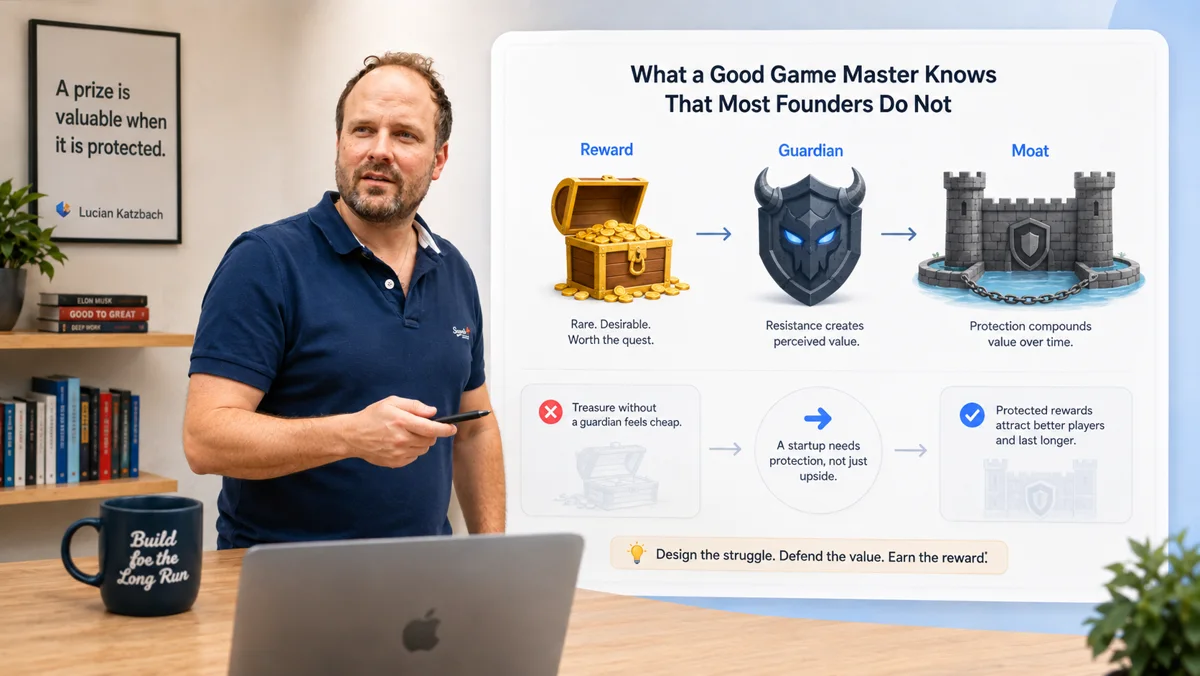
A good game master never simply places a treasure. They put a guardian in front of it, and they calculate carefully: the encounter has to be hard enough that the loot feels earned — but not so hard that the party gives up.
A treasure without a guardian feels like an achievement to nobody.
Your startup needs exactly the same thing. Not only the loot — customers, revenue, a higher valuation — but the moat in front of it that actually stops an imitator.
The matrix that shows where you actually stand
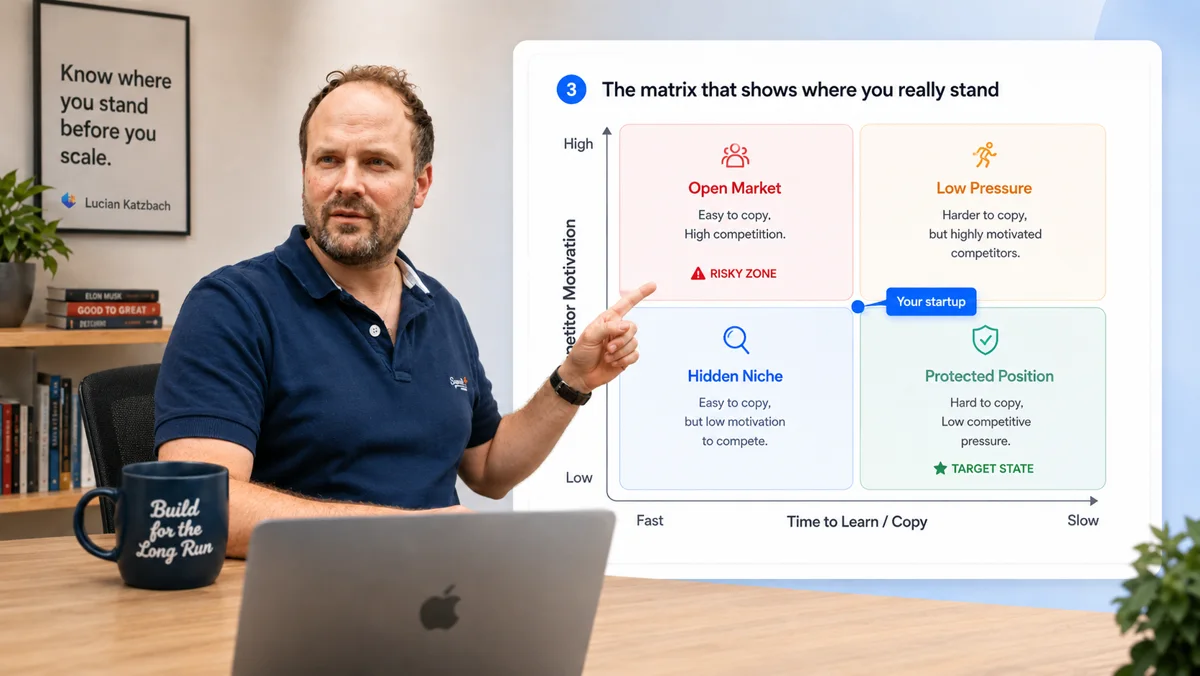
Two questions are enough to tell whether an advantage is a real moat or only looks like one:
How motivated would a competitor be to take this advantage in the first place? Is the market you hold big enough to attract imitators?
How quickly could they learn to do it? Would it take them a weekend — or years?
Plot your own advantage on those two axes and you get four quadrants.
 AI
AI
The open market is the most dangerous place to be: an advantage attractive enough to draw attention, but so easy to learn that anyone with the same AI tools can have a go at it.
This is where most technically strong but strategically unexamined startups end up — not because they are badly built, but because their advantage rests on feature complexity, interface or choice of model.
The protected position is where you want to be. Attractive, but the learning curve for an imitator is steep — not because nobody would try, but because it takes years rather than weekends.
What actually protects an advantage
 AI
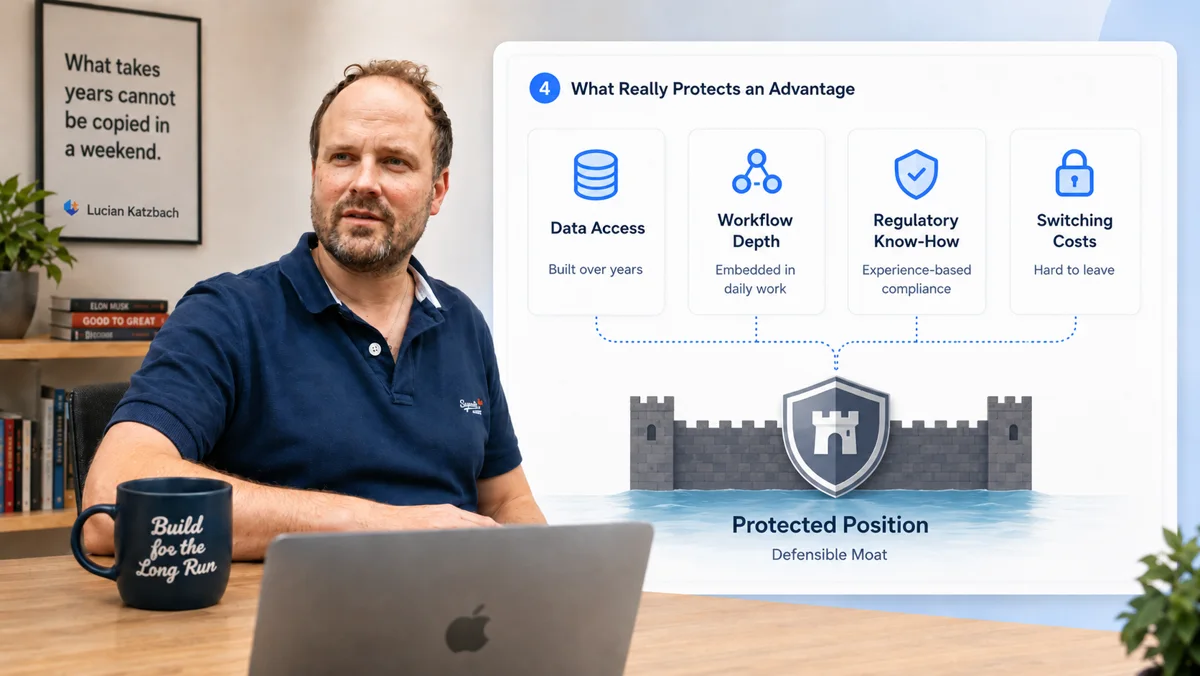
AIFour things reliably land in the protected position, because they take time that cannot be parallelised:
Access to data. Data that thickens over years of use cannot be caught up overnight, no matter how good a competitor's model is.
Depth in the workflow. A product embedded so deeply in a customer's work that switching disrupts the whole process rather than swapping out one tool.
Regulatory knowledge. An understanding of approval and compliance that only builds through real experience, not through reading.
Switching costs. A product where embedded data, configurations or habits make the customer part of the moat themselves.
None of those four can be rebuilt with an AI coding tool over a weekend. That is the difference.
The uncomfortable part
 AI
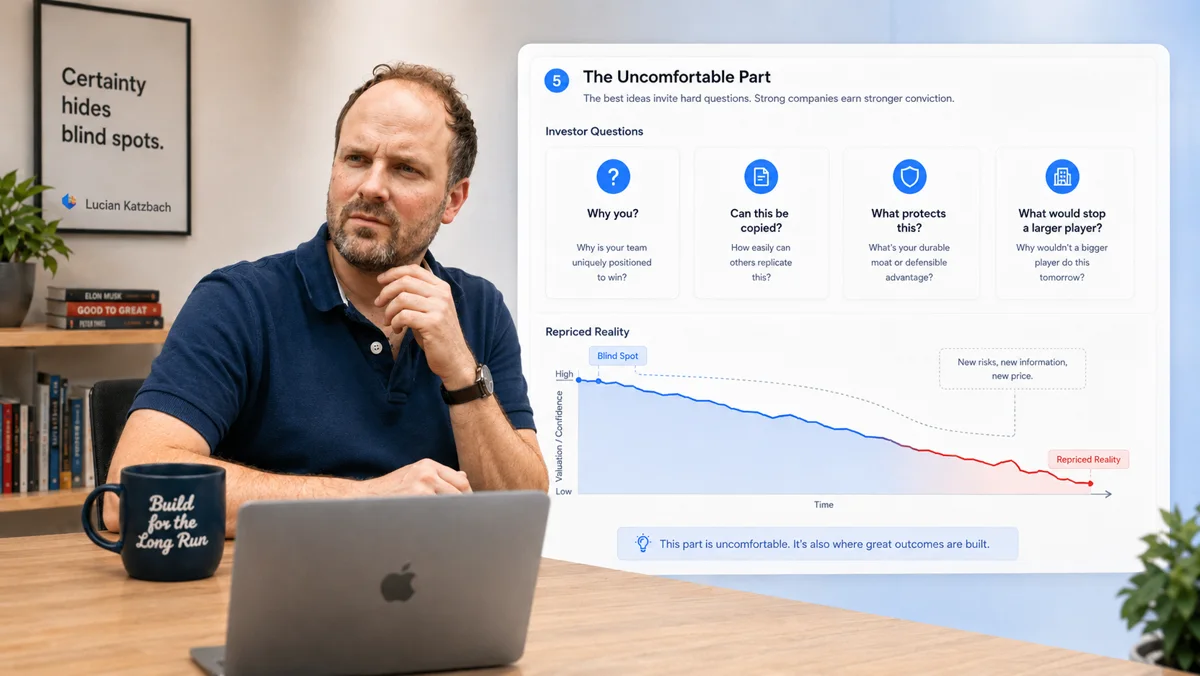
AIYou can fill in this matrix yourself now. But wherever you feel most certain is probably where you will flatter yourself the most.
A blind spot never feels like a blind spot. It feels like certainty.
I learned that the painful way. I once sat at a table with two investors. They asked a handful of pointed, critical questions. The seven-figure valuation I had worked so hard for shrank in a matter of minutes.
Not because my product was bad. Because I had mistaken an advantage for a moat when it was not one.
You do not have to learn it the painful way.
What counts in the end
The actual moat is not your feature set. Nor is it your pace. It is how quickly you learn to see your own blind spot before it costs you something — and how quickly you act once you have.
If you want to find out where your startup sits in this matrix, let us work it out together in a call. It takes 90 minutes at most and costs nothing. You leave with a concrete next step, whichever way the conversation goes.
— Lucian Katzbach