Gamification & learning
How authors become mentors – and EdTech products finally build real retention

Mentors as a strategic game changer — an invitation to think bigger
You have a good product.
But it is no longer enough.
Not in a market where users are looking for closeness, trust and real commitment.
Plenty of companies are standing at a turning point right now:
The numbers are okay — but something is missing.
More marketing feels like treating the symptom.
New features help but never really catch fire.
And internally the nervousness grows: "What if this is not enough?"
If you recognise yourself here, read on.
Because there is one innovation many overlook — although it lies directly in front of them.
What if the solution has long been part of your own company?
In many education companies there are excellent authors, teachers, subject experts.
They write, they design, they deliver content.
But that is only a fraction of what they could be.
What if you thought of your best minds not only as producersbut as mentors ?
Not everybody has to step into the spotlight.
But some of them have exactly what your product lacks today:
Trust. Presence. Resonance.
The Cleverly example: closeness scales
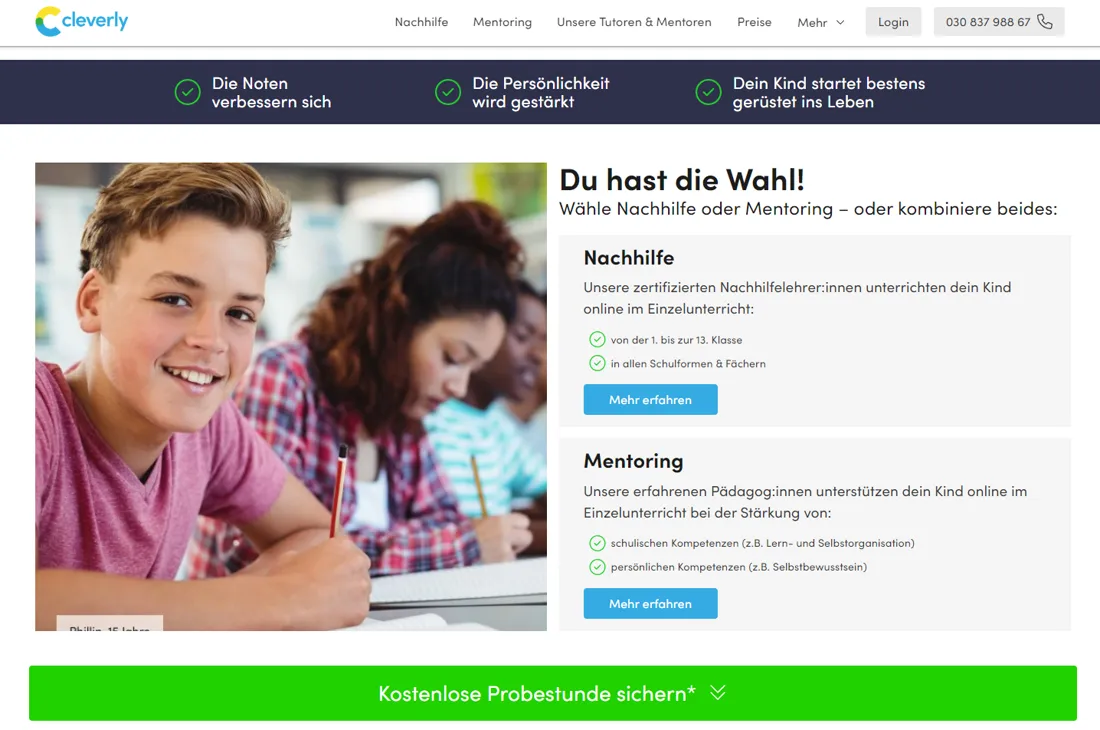
Cleverly showed how it works.
What used to be private tutoring was systematised:
young people coach others — digitally, personally, approachably.
Not revolutionary as a concept, but strong in the execution. And above all: scaled strategically.
Why does that work?
Because trust, identification and real feedback hold people more than any content can on its own.
If you run a learning platform today, explaining well is not enough.
You have to make sure somebody feels seen.
That somebody stays because they are no longer learning alone.
The neglected lever: your authors
In your company there are people who could do exactly that.
People who have been delivering quality for years — but were never lifted into a strategic role.
Why not?
Because the idea is missing.
Because nobody asked:
"What if we turned experts into real mentors?"
Not everyone will be suited to it.
That is fine.
But some can become the emotional backbone of your platform .
What does that change?
- You create trust — and with it Retention.
- You give your product a face.
- You meet your users emotionally.
- You differentiate yourself in a way that is hard to copy.
What you can do today
- Map your existing network.
Who are the best communicators, not just the best authors? - Find 1–2 pilot mentors.
Test formats: short videos, office hours, comments inside the learning system. - Rethink the relationship with the user.
Ask yourself: how accompanied does a pupil feel with us? - Measure the effect.
Does activity rise? Do people come back? Does the emotional bond grow?
This is not a nice extra.
This is strategic product developmentresting on a lever many overlook:
people.
Putting the right people at the centre at the right time has always been a game changer.
Perhaps that is exactly what your product is missing now.
And perhaps today is the day you call the first of those people.
Here are a few fitting ChatGPT/AI prompts that can help you:
To finish, here are a few prompts to copy out, in case you found yourself somewhere in this article.
Feel free to change them and adapt them so they fit you and your situation even better.
1. Strategic innovation without new development
Prompt 1.1:
"I am a (product manager) and my EdTech product runs okay, but we struggle to stand out from the competition without constantly building new features. How can I develop the product strategically without having to build new functions over and over?"
Prompt 1.2:
"I am a (managing director/CEO) and I feel the pressure of AI dominance changing the market. Which underrated levers of innovation can I use in my EdTech company to differentiate us clearly from the competition without setting a whole new course?"
Prompt 1.3:
"I am a (UX designer) and our user feedback says people like the product, but long-term attachment is missing. How can I improve the user experience in a targeted way without changing the entire product architecture or spending large resources?"
Prompt 1.4:
"I am an (editor) and my job is to create content for an EdTech product, but the product does not yet feel genuinely innovative. How can I help rework the existing content so that it contributes strategically to retention and stands out from the competition, without integrating new features?"
2. Retention through real connection
Prompt 2.1:
"I am a (product manager) and I notice that our users consume the content but never really stay for the long term. How can I build a strong emotional bond with our users so that they come back regularly and feel connected to the product, without constantly producing new content?"
Prompt 2.2:
"I am a (customer success manager) and despite high-quality content many of our users do not come back. How do I find the reasons, and how can I improve the user experience so that users stay motivated to learn regularly?"
Prompt 2.3:
"I am a (marketing manager) and my challenge is that our users are active once but never develop regular learning routines. What can I do to raise their intrinsic motivation so that they use our product lastingly rather than consuming it only now and then?"
Prompt 2.4:
"I am a (teacher) and I see that the pupils use our learning platform, but real attachment and long-term motivation are missing. How can I, as a teacher, involve my pupils more emotionally and make sure they use the product regularly and with more engagement?"
3. Mentorship as an element of product strategy
Prompt 3.1:
"I am a (product manager) and I want to build mentorship into our EdTech product as a strategic element. How can I win mentors from among our existing authors and subject experts and involve them effectively in the user experience, in order to create trust and attachment?"
Prompt 3.2:
"I am in (HR/team lead) and I want to see how we can turn authors with a lot of subject knowledge into mentors, in order to support our users better. How do I identify potential mentors, and which formats work best?"
Prompt 3.3:
"I am a (product manager / mentor) and I want to build mentorship into our product so that users feel they are not learning alone. How can I find mentors within my team who will take on that role, and how does that change our retention and our user experience?"
Prompt 3.4:
"I am a (teacher) and I am considering how to build my role as a mentor into a digital learning platform strategically. How can I use my expertise as a teacher to accompany pupils through the product, without it feeling like an extra obligation?"
Prompt 3.5:
"I am an (editor) and I wonder how I can convey more than knowledge through my content. How can I use strategic mentorship in my texts and formats to build a deeper bond with users and encourage them to come back regularly?"
4. Gamification that does not look like a game
Prompt 4.1:
"I am a (gamification expert / product manager) and I want to use gamification in our EdTech product, but without it looking like a children's game. Which techniques and principles work in professional learning contexts to raise user motivation lastingly?"
Prompt 4.2:
"I am a (UX designer / gamification expert) and I want to use gamification in a way that does not make users feel it is just another reward mechanic. How can we raise our users' motivation effectively without flooding them with classic gamification elements like points and badges?"
Prompt 4.3:
"I am a (product manager / UX designer) and my users report high motivation, but their interaction with the product stays low. Which psychological principles and gameful design approaches can we use to foster their intrinsic motivation and give them a sense of belonging and progress?"
Prompt 4.4:
"I am a (teacher) and I find it hard to motivate pupils over the long term. Which gamification techniques can I use not only to entertain pupils but to help them build regular learning habits and raise their engagement?"
5. Using existing resources instead of new budgets
Prompt 5.1:
"I am in (HR/product management) and I have a strong team, but we do not have the capacity to develop new features constantly. How can I deploy existing team members differently to improve the user experience and achieve more effect, without releasing a new budget?"
Prompt 5.2:
"I am a (product manager / UX designer) and I notice that our product is good, but users do not feel truly connected or motivated. What can I do when we have no resources to develop new features constantly but still want to keep the product alive and appealing?"
Prompt 5.3:
"I am in (HR / talent management) and I have the feeling that we are not using internal knowledge and talent effectively. How can I activate that knowledge to raise retention and develop our product strategically?"
Prompt 5.4:
"I am an (editor) and I find that we have a great deal of valuable knowledge in our EdTech platform, but retention stays below expectations. How can I raise long-term retention through clever use of existing resources and content, without making new investments?"
6. Thinking in terms that matter to investors
Prompt 6.1:
"I am a (managing director/CEO) and I want to improve our KPIs in order to stay attractive to investors. Which targeted measures can I take to raise retention and user attachment without relying on expensive marketing?"
Prompt 6.2:
"I am a (product manager / CFO) and our monetisation is not working perfectly yet, but we urgently need to improve the churn rate in order to look better in the next funding round. Which simple but effective levers can I activate to raise retention for the long term?"
Prompt 6.3:
"I am a (marketing manager / growth hacker) and we have little budget for paid user acquisition. How can I raise our users' activity and their return rate without extra marketing spend, and convince investors at the same time?"